

A Bearded Man in a Cap

late 1650s · Oil on canvas
Dimensions 78 x 66.7 cm
Collection: National Gallery, London
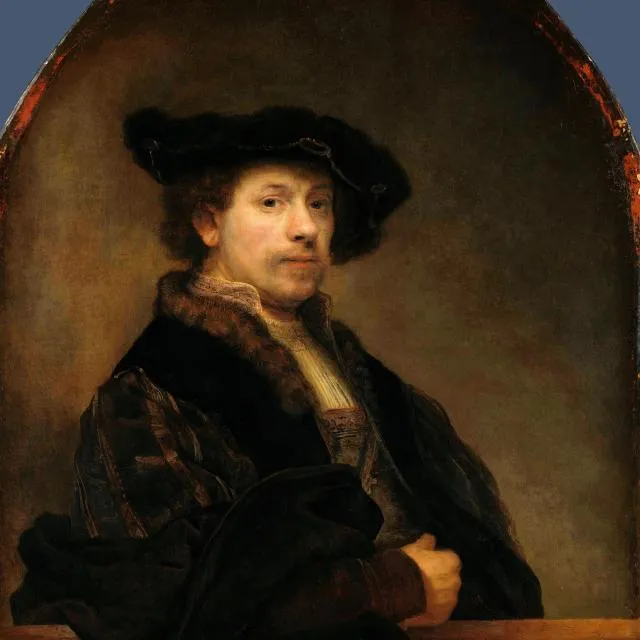
This is not a portrait of an individual person in the way we understand the idea today – the identity of the sitter wouldn‘t have been considered relevant, either to the artist or the person who bought the painting. Instead it falls into the category of tronies (literally ’heads‘). These were understood to represent a ’type‘ of person rather than an individual, and they were valued as a demonstration of the artist’s skill at portraying different characters and particular facial expressions in a convincing way.It is one of a group of such studies, almost certainly made from life, by Rembrandt in the 1650s. However, we can’t be absolutely sure of the date of this one. While the first three figures painted onto the canvas are clear (’165‘), the last digit is very faint. It could conceivably be the remains of a 3, but more likely the date is 1657. The free use of the brush, the deep background shadows, the very limited palette of browns and ochres and the way the painter has concentrated on the detail of the face, eyes and beard while only sketching in the rest of the picture are all consistent with Rembrandt’s style for the late 1650s and 1660s.Sometime in the mid-nineteenth century the painting was given the title ’A Jewish Rabbi‘, probably because the man’s divided, square-cut beard and his exotic hat, which was not typical of everyday dress at the time, suggest that he might be Jewish. Rembrandt lived near the Jewish quarter of Amsterdam and painted several portraits of Jews, and the same man also seems to have been used by the artist as a model for the so-called Portrait of a Rabbi, 1657 (Palace of the Legion of Honor, San Francisco). However, there’s no evidence that the title ’A Jewish Rabbi' was used before 1844, when the National Gallery bought the painting. The man also seems to have sat as a model in other works which Rembrandt made during the 1650s and 1660s, including Aristotle contemplating the Bust of Homer (Metropolitan Museum of Art, New York) and A Bearded Man (State Hermitage Museum, St Petersburg). The hat also seems to be the same one used in other paintings by Rembrandt, including his own Self Portrait at the Age of 34. Far from being the hat worn by an individual rabbi, it was probably a studio prop used when Rembrandt was trying to evoke a sense of history or exotic dress in a painting.This painting caught the attention of the great eighteenth-century portraitist Thomas Gainsborough, who made a copy of it in about 1770 (Royal Collection, London).
85 collected·90 zoomed·0 comments
About this artwork
A Bearded Man in a Cap (late 1650s) by Rembrandt, oil on canvas, from the National Gallery, London collection.
About Rembrandt
Rembrandt Harmenszoon van Rijn (15 July 1606 – 4 October 1669) was a Dutch draughtsman, painter, and printmaker. An innovative and prolific master in three media, he is generally considered one of the greatest visual artists in the history of art and the most important in Dutch art history.
More by Rembrandt
Comments (0)
No comments yet. Be the first to share your thoughts.