

A Horse frightened by Lightning

about 1813-14 · Oil on canvas
Dimensions 48.9 x 60.3 cm
Collection: National Gallery, London
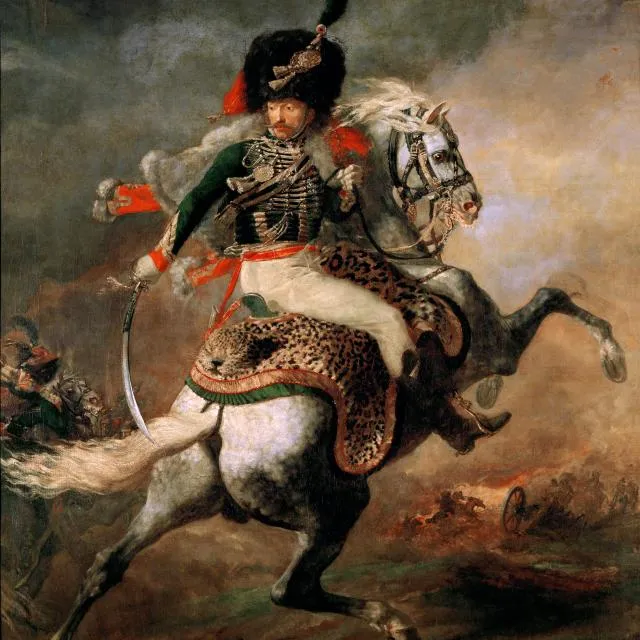
Jean-Louis-André-Théodore Géricault was a keen horseman, and his passion for horses was matched by his expert understanding of their anatomy. Unlike England, France did not have an established tradition of horse painting. However, there were French artists who specialised in painting horses – such as the fashionable Carle Vernet, himself an avid horseman and with whom the young Géricault had trained – and a market for these pictures.It is likely that Géricault painted this picture in 1813 or 1814, soon after he had successfully exhibited a huge canvas, The Charging Chasseur (also known as An Officer of the Imperial Horse Guard Charging, Louvre, Paris) at the Salon of 1812, for which he was awarded a gold medal. In 1813 he produced a number of oil studies and finished paintings of horses at the Imperial stables at Versailles, possibly including this one, showing them either in groups or individually. In contrast to the action and movement of The Charging Chasseur, these paintings are characterised by close observation and detailed naturalism.In this picture we see a fine thoroughbred, possibly of Arabian stock. Géricault has shown the moment it reacts to a bolt of lightning (in the upper right corner), and presumably the accompanying clap of thunder. He avoided the more dramatic, and perhaps rather clichéd, image of a horse rearing, instead showing the animal in profile as it freezes in fear. Only its startled eye – the white just visible – and the trace of drool from its mouth suggest its terror. Géricault brilliantly captured the sheen of its dappled coat as it is momentarily lit up against the near blackness of the night sky. He used short, staccato strokes of liquid paint, which precisely follow the contours of the horse’s body, to create an effect of nervous energy that ripples across its silky surface.Unlike the pictures of horses in their stables at Versailles, Gericault has excluded any human presence or incidental detail, such as riding equipment or an identifiable location. Instead, his attention – and ours – is entirely focused on the horse. Filling the picture space, it exists beyond passing changes in fashion and style. Like George Stubbs’s masterpiece Whistlejacket, Gericault’s painting is a portrait of a specific horse, with its own distinct characteristics, rather than a generic study of a type or breed. Although showing a frightened animal, Géricault has avoided sentimentalism. Nor has he humanised its reaction to the lightning. But like Stubbs’s picture, his precise observation of this particular horse also draws upon classical precedents. The side view recalls classical friezes, whose impact upon Géricault’s paintings of horses and of horse racing was to become more pronounced when he visited Italy between 1816 and 1817.
129 collected·172 zoomed·0 comments·2 boards
This artwork is in 2 boards
About this artwork
A Horse frightened by Lightning (about 1813-14) by Theodore Gericault, oil on canvas, from the National Gallery, London collection.
About Theodore Gericault
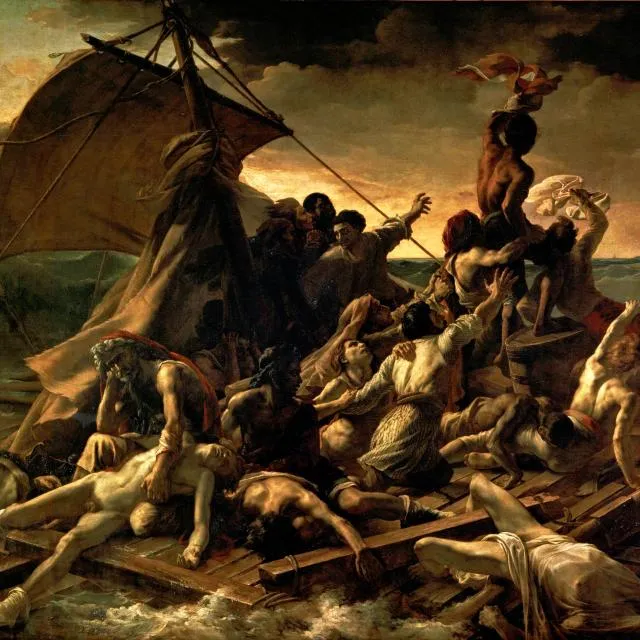
Jean-Louis André Théodore Géricault (26 September 1791 – 26 January 1824) was an influential French painter and lithographer, whose best-known painting is The Raft of the Medusa. Although he died young, he was one of the pioneers of the Romantic movement.
More by Theodore Gericault

Comments (0)
No comments yet. Be the first to share your thoughts.