

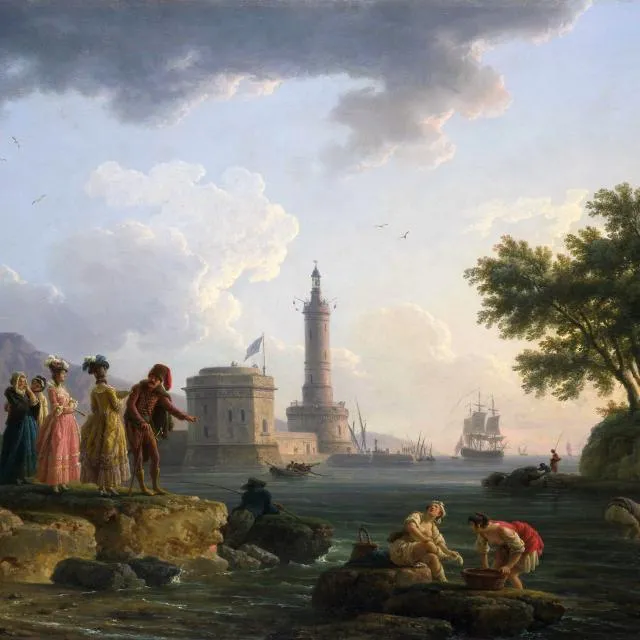
A Landscape at Sunset with Fishermen returning with their Catch ('Calme')

1773 · Oil on canvas
Dimensions 114.5 x 163.5 cm
Collection: National Gallery, London
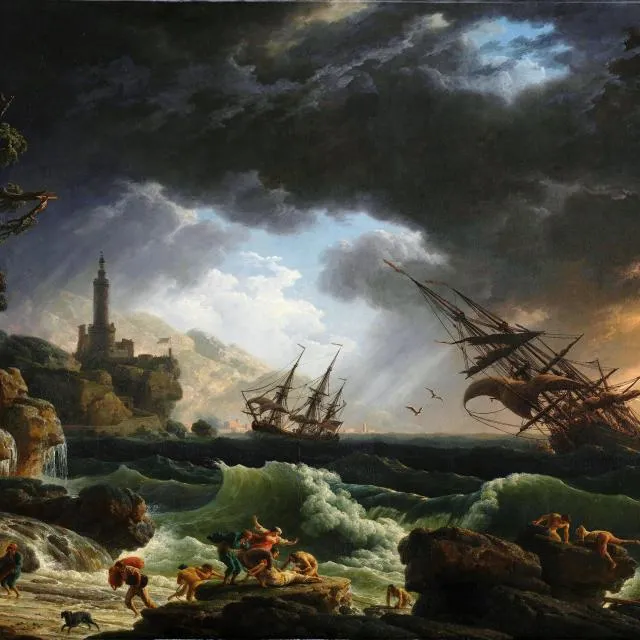
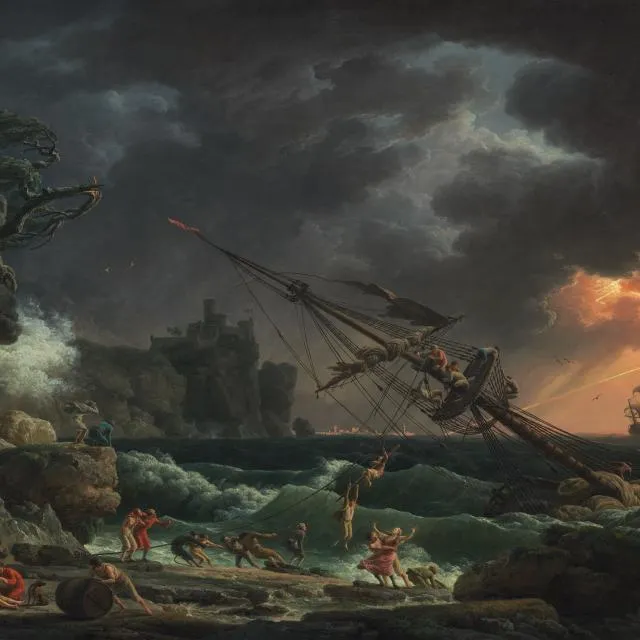
This is one of two paintings originally commissioned as a pair by Stanislas Augustus, King of Poland, in June or July 1772. However, concerned that the King was slow to pay, Vernet instead sold the pictures to the British officer and East India Company official Lord Clive (known as Clive of India).‘Calme’, which Vernet painted first, shows an imaginary harbour as fishermen return with their catch on a tranquil summer’s evening. The golden setting sun is at the centre of the painting above the misty horizon, its light illuminating the undersides of the clouds and reflecting off the ripples on the calm sea. At the entrance to the port is a lighthouse and some fortifications; a classical temple stands on the left-hand shore at the foot of a high wooded mountain. A ship has just arrived – it is just possible to make out the tiny figures on its mast yards furling the sails – and is being towed by two launches into the harbour.In his letter to Clive’s agent, the English banker Henry Hoare, Vernet wrote about this painting: the ‘foreground is bedecked with numerous figures: fishermen unloading their catch from a boat, women waiting to get hold of them; a fisherman with a rod with his wife sitting next to him make a contrast to the sun’s disc, which is striking; overall this picture has a rich, harmonious composition.’Light, shadow and atmosphere are the true subjects of Vernet’s painting, the figures in the foreground merely a foil to the hazy meeting of water, light and air. The painting follows in the tradition of the Italianate seaport paintings of Claude such as A Seaport of 1664, and Seaport with the Embarkation of Saint Ursula of 1641. In the pendant painting, ‘Tempête’ (‘Storm’), Vernet explores contrasts of light and extremes of weather.Vernet’s landscapes and seascapes and the effects of weather were perceived as true to nature, and the ships in his marine views were based on careful observation. The nearest ship seen here is a two-decker of 50 guns with a correct build for the 1770s, probably a warship since it is flying a long naval style pennant, an exaggeratedly long Dutch flag, and possibly an East Indiaman.Vernet’s paired seascapes were intended to have an emotional effect on their viewers, the serene beauty of ‘Calme’ contrasting with the sublime horror of ‘Tempête’. He was exploring fashionable ideas expressed in Edmund Burke’s A Philosophical Enquiry into the Origins of Our Ideas of the Sublime and the Beautiful (1757; first French edition 1765) – a text that had a significant influence on the Romantic and Gothick movements in European art and literature.These are two of Vernet’s greatest marine paintings and the type of work for which he was most famous in his day. They are the only great pair of marine views by him in a British public collection.
132 collected·134 zoomed·0 comments
About this artwork
A Landscape at Sunset with Fishermen returning with their Catch ('Calme') (1773) by Claude Joseph Vernet, oil on canvas, from the National Gallery, London collection.
About Claude Joseph Vernet
Claude-Joseph Vernet (14 August 1714 – 3 December 1789) was a French painter. His son, Antoine Charles Horace Vernet, was also a painter.
More by Claude Joseph Vernet
Comments (0)
No comments yet. Be the first to share your thoughts.