

A Landscape with a Waterfall and a Castle on a Hill

probably 1660-70 · Oil on canvas
Dimensions 101 x 86 cm
Collection: National Gallery, London
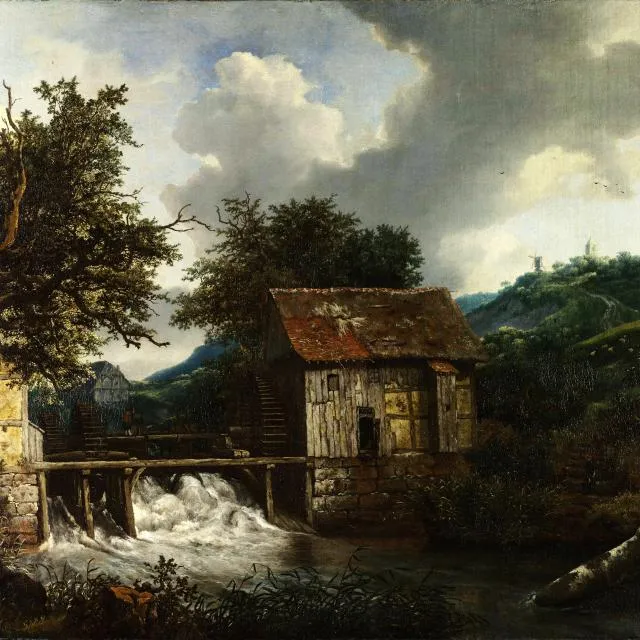
Heavy, rain-dark clouds loom over a rugged landscape of scrubby trees, crags and three pines dramatically silhouetted against the sky. Right in the centre of the picture, a river emerges black and mirror-like from a fold in the hills, transforming into a seething cauldron as it tips over a rock ledge. In the scattered boulders and the tree trunks washed against the bank in the foreground, we can sense the power and drama of mountain landscapes, where rain swells surging rivers to the point where they are strong enough to roll rock and fell timber.Jacob van Ruisdael seems to be contrasting the immense energy of the tumbling water and the upright strength of the three towering pines with the human impact on this environment. We can make out the faint outline of a church tower on the left, while the grey turret of what seems to be a ruined castle is half hidden by trees and bushes on the right. But unless we look carefully, we hardly notice these buildings, nor the tiny figures on the path in the foreground. In this craggy wildness, the artist seems to be implying, there are far greater forces at work.Despite its apparent realism, this landscape has not been observed from life. It probably dates from the 1660s, when van Ruisdael composed many such scenes seemingly inspired by the work of Allart van Everdingen, who had visited Scandinavia in 1644 and made a number of drawings of rocky mountains with torrents and waterfalls. While van Ruisdael had never visited such a landscape, he did spend time observing the effects of water surging through sluices. These were all around him in Amsterdam, where the level of the canals was controlled by locks, but he also made many paintings of the watermills at Singraven, on the border between Holland and Germany. We have one in our collection: Two Watermills and an Open Sluice at Singraven.Depicting fast-flowing water in a convincing way is one of the greatest challenges of landscape painting, and it is one which seems to have particularly fascinated van Ruisdael. As well as the watermill paintings, waterfalls feature in dozens of his pictures. This one is a good example of the effectiveness of his techniques. He used short, extremely varied brushstrokes – tiny swirls, flecks, streaks and smudges of slightly different shades of white paint to evoke the turbulent water tumbling over the yellowy greens and blacks of the boulders. Particularly successful is the way he has stippled the paint with the end of his brush to give the effect of the backsplash of foam as it hits rock, as in the very centre foreground of the painting.
152 collected·223 zoomed·0 comments
About this artwork
A Landscape with a Waterfall and a Castle on a Hill (probably 1660-70) by Jacob van Ruisdael, oil on canvas, from the National Gallery, London collection.
About Jacob van Ruisdael
Jacob Isaackszoon van Ruisdael (Dutch pronunciation: [1629 – 10 March 1682) was a Dutch painter, draughtsman, and etcher. He is generally considered the pre-eminent landscape painter of the Dutch Golden Age, a period of great wealth and cultural achievement when Dutch painting became highly popular.
More by Jacob van Ruisdael
Comments (0)
No comments yet. Be the first to share your thoughts.