

A Man and a Woman seated by a Virginal

about 1665 · Oil on oak
Dimensions 38.4 x 32.2 cm
Collection: National Gallery, London
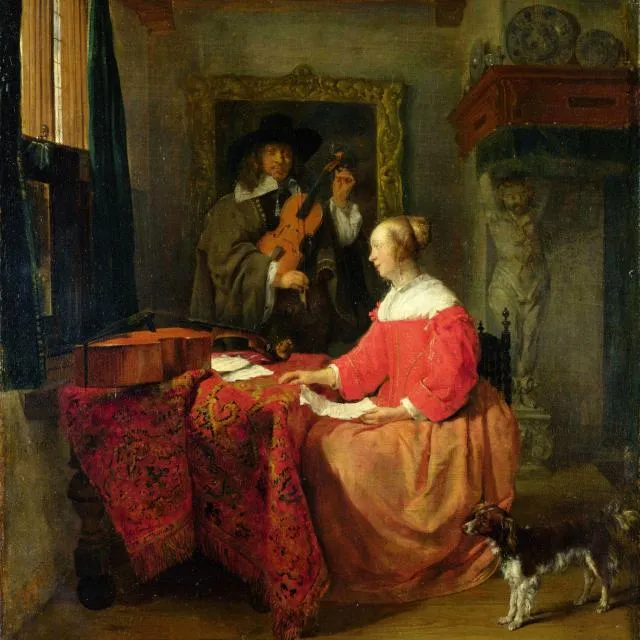
A young couple, their eyes cast shyly downwards, seem about to strike up a duet. The woman, seated at the keyboard of a virginal, hands her partner a musical score, presumably the part for the violin on the table next to him. But his bow is nowhere to be seen and, in return for the score, he is offering her a glass of wine.Scenes of music making among young people were common in Dutch seventeenth-century painting, and they would certainly have been understood as references to romantic love. Nearly 400 years later, it is much harder to know if and when we should also read more overtly sexual references into them. In some paintings, a wine glass held at the angle it is here clearly functions as a phallic symbol. But if there is an implication of that kind in this picture, it’s relatively subtle. The more obvious parallel set up by Metsu is between the wine glass proffered by the young man and one in the painting in the left background.Partly covered by a curtain – a traditional arrangement in Dutch houses at the time – we can make out just enough to identify it as a reference to an earlier work by Metsu himself (Alte Pinakothek, Munich). It depicts a kitchen or tavern scene on Twelfth Night (6 January), a celebration which commemorates the arrival of the Three Kings in Bethlehem but also marks the end of Christmas festivities. As such, it was a rowdy, drunken affair when people dressed up as kings, fools or other grotesque characters. Metsu’s earlier painting has a very similar figure to the one depicted in the painting behind the curtain. He is drinking and wearing a paper crown, though here, in the later copy, the composition has been reversed and the size of the figure increased.The young man sitting by the virginal is drinking from a long wine glass which is very similar to the one held by the reveller in the background painting. So it may be that Metsu is making a link between a scene of apparent musical innocence and the potential that, fuelled by alcohol, it might lead to debauchery. The Latin inscriptions on the virginal would therefore seem to be a wry comment on the situation. Both taken from the Old Testament Book of Psalms, the one on the lid refers to the line, ‘In thee, O Lord, do I put my trust; never let me be put to confusion’, an implied warning against loss of virtue. The one below it, on the inside of the keyboard cover, is translated as, ‘Let every thing that hath breath praise the Lord’, thus advocating the importance of Christian worship. But as was so often the case in Dutch painting, the mood is not overtly judgemental. Sexual transgression seems to have been considered as a source of amusement as much as a subject for condemnation.The same virginal (with slight variations) with the same inscriptions occurs in other paintings by Metsu, for example Lady at a Virginal (Museum Boymans-van Beuningen, Rotterdam). He may have used a particular instrument as a model. The second inscription can be found on a virginal of 1620 (Musée Instrumental du Conservatoire, Brussels) which also has a very similar pattern on the front.
42 collected·23 zoomed·0 comments
About this artwork
A Man and a Woman seated by a Virginal (about 1665) by Gabriel Metsu, oil on oak, from the National Gallery, London collection.
About Gabriel Metsu
Gabriël Metsu (1629–1667) was a Dutch painter of history paintings, still lifes, portraits, and genre works. He was "a highly eclectic artist, who did not adhere to a consistent style, technique, or one type of subject for long periods". Only 14 of his 133 works are dated.
More by Gabriel Metsu
Comments (0)
No comments yet. Be the first to share your thoughts.