

A Nymph by a Stream

1869-70 · Oil on canvas
Dimensions 66.7 x 122.9 cm
Collection: National Gallery, London
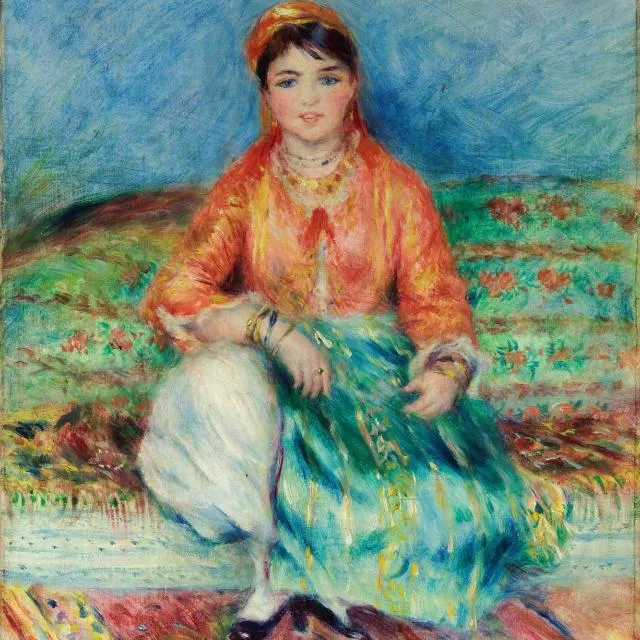
This is one of the first nudes that Renoir painted. He took a traditional artistic approach, depicting her in a natural setting, reclining by a stream as though she were a naiad (water nymph) from the world of Greek mythology. Such nymphs or spirits were associated with the forces of nature itself. Streams and especially springs were considered a symbolic source of life, and Renoir must have been aware that the theme had been recently explored by other prominent artists of the time, including Ingres and Courbet.The figure appears to be lying on a grassy flower-flecked bank beside the stream, leaning with her elbow in the brook and allowing the water to flow between her fingers. But Renoir’s brushstrokes are so fluid that we can’t be entirely sure where the bank ends and the water begins. The title, which may be original, can also be translated as ‘Nymph at the Spring’. So perhaps she is actually lying in the water and not beside it, and the little white flowers are those of, say, watercress rather than a riverside meadow. The way that Renoir has blurred the outline of the figure and the way her garlanded hair seems to flow into the background contributes to this sense that she is merging into her surroundings. Nevertheless, Renoir draws a strong contrast between the deep shadowy greens of the vegetation and water and the glowing white flesh of the woman, which is modelled with subtle shades of pink and grey.This painting is also – in some senses – a portrait. Rather than idealising the nymph’s features in the way that more academic contemporary painters such as Ingres would have done, Renoir has made her recognisable. She is Lise Tréhot, the artist’s lover and the female model for almost all of his work during the early stages of his career between 1866 and 1872, after which they seem to have broken off all contact with each other. She appeared in more than 20 paintings. As she gave birth to a daughter, Jeanne, in July 1870, she may have been pregnant when this picture was made. Jeanne was given up for adoption and Renoir never publicly acknowledged that he was the father, though since he secretly supported Jeanne financially all her life, it seems safe to assume that he was.Lise also posed for what is presumed to be a companion piece to this painting, Woman of Algiers (National Gallery of Art, Washington, D.C.), in which she is depicted in a similar pose but clothed in a rich oriental (near-Eastern) costume as though she is in a harem. The two paintings are almost exactly the same size with the position of the figure reversed, which suggests that they were made to hang next to each.The concept of painting the same model twice – dressed in one picture and undressed in the other, and with all the frisson that implied – was not a new one. Traditional artistic training required the study of nudes in order to understand how to depict a fully dressed figure. And the idea of a double portrait of this kind had been most famously expressed by Goya in his two portraits of about 1800 depicting a clothed and naked maja (a term which is hard to translate but means a feisty working class young woman). She too is shown full-frontal, and, like Renoir’s nymph, she holds the eye of the viewer with a direct gaze.
138 collected·234 zoomed·1 comments·1 boards
This artwork is in 1 board
About this artwork
A Nymph by a Stream (1869-70) by Auguste Renoir, oil on canvas, from the National Gallery, London collection.
About Auguste Renoir
Pierre-Auguste Renoir, commonly known as Auguste Renoir (25 February 1841 – 3 December 1919), was a French artist who was a leading painter in the development of the Impressionist style.
More by Auguste Renoir
Comments (0)
No comments yet. Be the first to share your thoughts.