

An Allegory ('Vision of a Knight')
about 1504 · Oil on poplar
Dimensions 17.1 x 17.3 cm
Collection: National Gallery, London
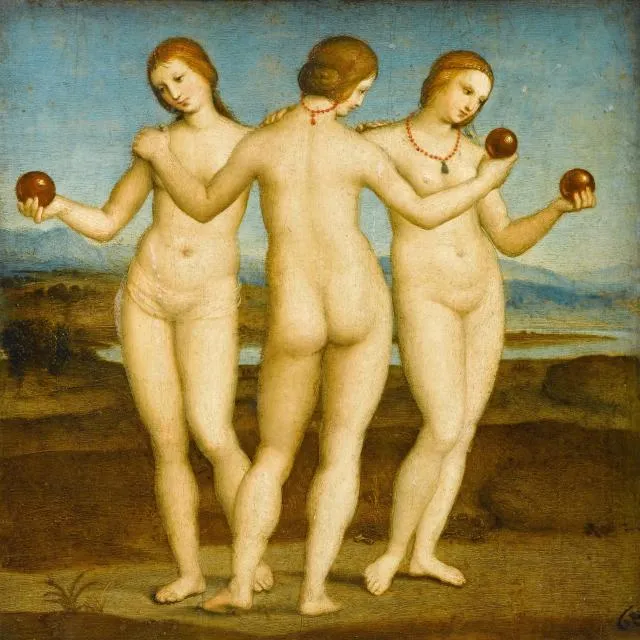
This painting was inspired by a passage in the Punica, an epic poem by Silius Italicus (AD 25–101) recounting the story of the Second Punic War. This particular scene had never been painted before, and Raphael may have been directed to it by a learned friend or patron. The little square panel is painted with minute attention to detail and a jewel-like finish, reminiscent of a manuscript illustration.While resting in the shade of a bay tree, the young soldier Scipio has a vision of two ladies, Virtue and her adversary Pleasure. Virtue promises Scipio honour, fame and glory through victory in war. Pleasure, with fragrant flowing hair and beguiling eyes, promises a life of ease and serenity. Virtue on the left is soberly dressed with her hair covered. She offers Scipio a book and a sword, emblems of learning and valour. Pleasure’s dress is hooked up at her hip and her fair hair escapes from her billowing veil as she offers Scipio a sprig of flowers, standing for love. The hard path of virtue is represented by the craggy rock in the background, while Pleasure’s gentle meadows slope down to the shores of a lake.Silius’s passage was based on the story of Hercules at the crossroads, in which the hero had to choose between the paths of virtue and pleasure. Scipio, like Hercules before him, chose Virtue with her accompanying trials, victories and fame. Raphael would have been familiar with the story of the choice of Hercules since the legend inspired the prologue of his father Giovanni Santi’s epic poem about the life and deeds of Federigo da Montefeltro, Duke of Urbino. Raphael’s father’s version is the only one in which the hero is asleep.Raphael interpreted the theme not as a moral dilemma but rather as a combination of all the virtues to which an ideal soldier or knight should aspire. The evergreen leaves of the bay tree in the centre of the symmetrical composition symbolise the lasting honour a good knight could hope to win through his military, scholarly and amorous activities. In the cartoon for the painting (British Museum, London) Raphael originally drew Pleasure as a more seductive figure in a low-cut dress. However, in the finished picture she is more modestly dressed, emphasising her role here as the knightly prize, Love.An Allegory is first recorded in the Borghese collection in Rome in the seventeenth century together with a painting identical in size and style now in the Musée Condé, Chantilly. This shows the Three Graces – Chastity, Beauty and Love – each holding a perfect golden ball. The two paintings were probably conceived as a pair although they were probably not intended to be displayed side by side, as the figures are different sizes. It is likely that either one picture was intended as the cover for the other and they were framed back to back, or that they were kept as treasures in a cloth bag or drawer. The combination of the traditionally masculine virtues of courage, learning and love with the traditionally feminine virtues of chastity, beauty and love suggest that the two little paintings may have been made to mark the occasion of a marriage.
61 collected·82 zoomed·0 comments
About this artwork
An Allegory ('Vision of a Knight') (about 1504) by Raphael (Raffaello Sanzio da Urbino), oil on poplar, from the National Gallery, London collection.
About Raphael (Raffaello Sanzio da Urbino)
(March 28 or April 6, 1483 – April 6, 1520) Raffaello Sanzio da Urbino known as Raphael, was an Italian painter and architect of the High Renaissance. His work is admired for its clarity of form, ease of composition, and visual achievement of the Neoplatonic ideal of human grandeur.
More by Raphael (Raffaello Sanzio da Urbino)
Comments (0)
No comments yet. Be the first to share your thoughts.