

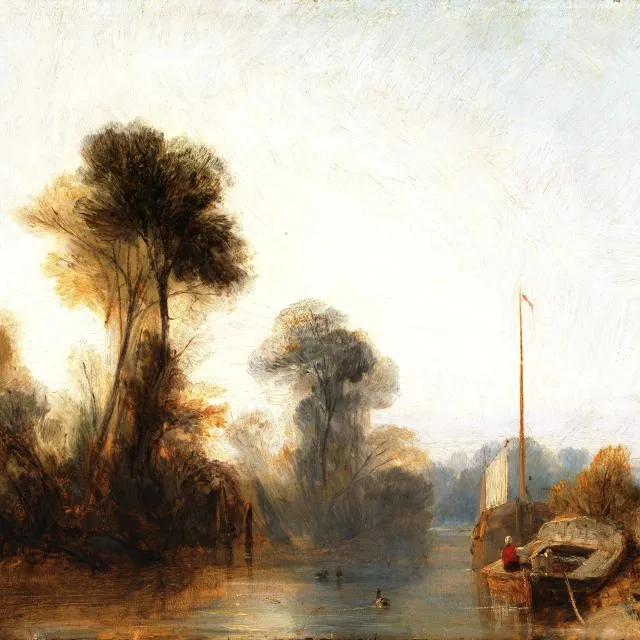
An Estuary in Northern France, possibly that of the River Somme

about 1825-7 · Oil on fibre board
Dimensions 16.7 x 27.9 cm
Collection: National Gallery, London
Bonington probably painted this around 1825-7 at La Ferté, on the estuary of the river Somme in northern France. His parents were English, but the family emigrated to France in 1817, when he was 15. Having enrolled in the Paris studio of the history painter Baron Gros, he abandoned academic training for landscape painting, travelling extensively in northern France, particularly in Normandy and Picardy. La Ferté and nearby St Valèry-sur-Somme were among his favourite haunts, which he frequently visited with his painting companions, who included Paul Huet.As with Turner, Bonington’s early experience as a watercolourist profoundly influenced his approach to oil painting. In La Ferté, which was painted outdoors on site, Bonington uses swift, fluid stokes of thinly applied oil paint, which in places barely covers the surface of the board, to create an immediacy usually achieved with watercolour. This is enhanced by his painting directly onto wet paint, rather than gradually building up layers or glazes over time. Look closely and you can see this in the mound’s edge, just to the left under the seated figure, and in the distant land on the horizon. Bonington makes no attempt to hide the track of the brush’s bristles through the paint. Not only are brush marks clearly visible – for example, in the long, horizontal strokes of the river bank and the short, vertical strokes of the clouds on the left – but the mix of long sweeps and shorter cross-hatching further adds to the liveliness of the picture. Having laid down broad areas of colour (limited to gradations of white, blue and a greyish ochre), Bonington creates detail and atmospheric distance by mainly using white, black and red paint, which he applies in thin liquid streaks (for the breaking waves) or with small blobs or drops (in the seated figure). These details, including the beached boat created out of a flurry of scribbled brushstrokes, may have been added later in the studio.Bonington’s method of painting directly outdoors and of recreating the freshness and immediacy of a watercolour sketch in an oil painting had a great impact upon French artists in the 1820s. During the Napoleonic wars, travel and cultural exchange between Britain and France had ground to a halt, but with Napoleon’s defeat in 1815 it resumed. The 1820s, especially, saw intense French interest in British culture, and British artists, including Bonington and Constable, showed their work at the Paris Salon throughout the decade. Many French artists admired the technical freedom and expressiveness of the British painters. As the critic Théophile Gautier noted, ‘With regard to colour, the revolution in painting proceeded from Bonington’. Bonington’s work had a direct effect upon Eugène Delacroix, who befriended him when they met in Paris. Delacroix observed: ‘One can find in other modern masters qualities of strength and precision superior to those in Bonington’s pictures, but no one in this modern school, and possibly even before, has possessed that lightness of touch which, particularly in the watercolours, makes his work a type of diamond that flatters and ravishes the eye, independently of any subject matter and any imitation.’
70 collected·60 zoomed·0 comments·1 boards
This artwork is in 1 board
About this artwork
An Estuary in Northern France, possibly that of the River Somme (about 1825-7) by Richard Parkes Bonington, oil on fibre board, from the National Gallery, London collection.
About Richard Parkes Bonington
Richard Parkes Bonington (25 October 1802 – 23 September 1828) was an English Romantic landscape painter, who moved to France at the age of 14 and can also be considered as a French artist, and an intermediary bringing aspects of English style to France.
More by Richard Parkes Bonington
Comments (0)
No comments yet. Be the first to share your thoughts.