

An Extensive Landscape with Ruins

probably 1665-75 · Oil on canvas
Dimensions 34 x 40 cm
Collection: National Gallery, London
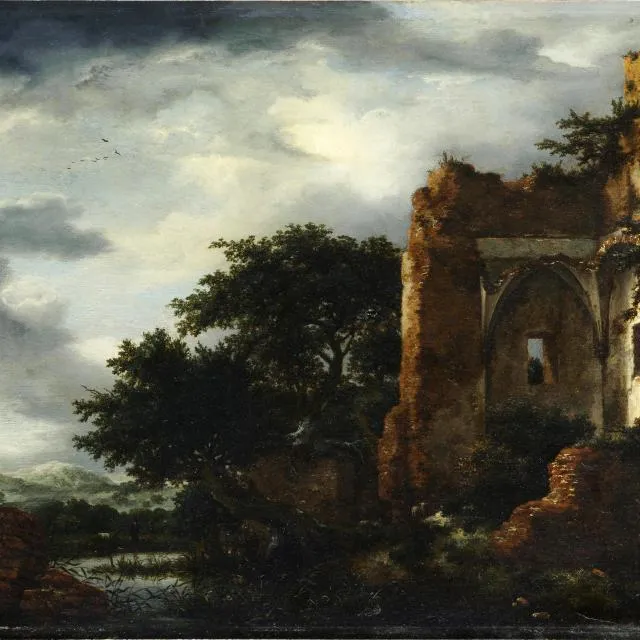
A grey and turbulent sky dominates the picture, but our eye is caught by the patch of bright sunlight in the middle ground. And if we look deeper, just to the right of the church, there are other flecks of yellow where the sun has broken through the clouds. This sense of fast-changing light brings the whole landscape to life, injecting movement into what otherwise might have been a static scene.These brilliant lighting effects may help make it feel as though van Ruisdael has captured a real moment in a real landscape, but he almost certainly hasn’t. Instead, he has brought a fantasy to life. Despite much research, no art historian has managed to establish where exactly this scene might be; no one has convincingly identified the church, nor the ruins in the foreground. Even more tellingly, the National Gallery has two versions of the scene. Significant differences between them suggest that van Ruisdael was more interested in arranging key elements in a pleasing way than in describing a particular place. In the larger picture, one of the ruined buildings in the foreground has been removed and replaced with a group of figures. The woodland and vegetation have been rearranged, the church moved much closer to the ruins, other spires and towers added to the horizon and a windmill placed in the centre of the picture.It is possible that one of the two versions is a true account of what van Ruisdael saw and the other is an adaptation. But it’s much more likely that he was composing an idealised landscape – based on the countryside around Haarlem – and reflecting an idea that he and his customers had about how Holland should look and what was important to them. This is a rich pastoral harmony: the harvest is underway and a shepherd tends his flock. It is also a land framed by water. There is a fisherman on the moat in the foreground and, in the distance, a thin band of grey bounds the horizon: the sea. It reminds us of other vital sources of wealth – the great trading networks of the Dutch maritime fleet.We seem to be led to understand that all of this represents a bounty offered and protected by God. The church is central to the picture. Its tower and spire stand tall and resilient against an impending storm – a source of strength when times get rough. Other strongholds, like the ruined medieval castle in the foreground, slowly crumble.In fact, different ideas of time are central to this painting. While the church suggests eternity and the ruins suggest the long span of history, that flash of sunlight makes it clear that we are witnessing a fleeting moment in the ever-changing weather. A sense of the rhythm of the seasons is strong too. This is clearly high summer. The trees are in leaf and sheaves of corn are lined up in the field, but the heavy grey sky reminds us that soon it will be autumn.
72 collected·64 zoomed·0 comments
About this artwork
An Extensive Landscape with Ruins (probably 1665-75) by Jacob van Ruisdael, oil on canvas, from the National Gallery, London collection.
About Jacob van Ruisdael
Jacob Isaackszoon van Ruisdael (Dutch pronunciation: [1629 – 10 March 1682) was a Dutch painter, draughtsman, and etcher. He is generally considered the pre-eminent landscape painter of the Dutch Golden Age, a period of great wealth and cultural achievement when Dutch painting became highly popular.
More by Jacob van Ruisdael
Comments (0)
No comments yet. Be the first to share your thoughts.