

An Old Woman ('The Ugly Duchess')

about 1513 · Oil on oak
Dimensions 62.4 x 45.5 cm
Collection: National Gallery, London
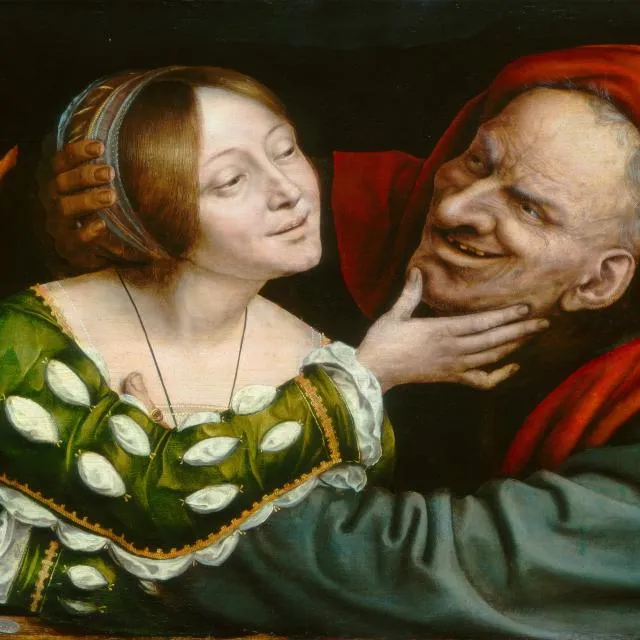
This must be one of the most striking studies in ugliness in Western painting. An elderly woman with a very short nose and an exceedingly long upper lip rests one hand on a marble parapet. Folds of skin hang loose around her jaw and neck, and she seems to have lost all her teeth. Her skin is pimply and marked with broken veins, and hairs spout from the wart on her cheek. She is evidently suffering from an advanced stage of Paget’s disease, which deforms the bones: her nose is pushed up, her nostrils are unusually arched and her chin and collarbones are abnormally enlarged. Her ears stick forwards and her forehead bulges.She is, however, elegantly and aristocratically dressed – although by the time this picture was painted in the early sixteenth century her clothes would have been many years out of date. Her large wrinkly breasts are forced upwards by her tightly laced dress, and she holds the bud of a red rose in front of her cleavage. Her hair is concealed in the horns of a heart-shaped bonnet, over which she wears a white veil held in place by a large gold brooch decorated with roses and set with pearls and a diamond.This painting is part of a pair: her ‘other half’ is in a private collection in New York. Both are wearing fanciful adaptation of Burgundian fashions of the early fifteenth century, and the Old Man is very like a portrait of Philip the Bold, Duke of Burgundy. Various possible identities have been suggested for the woman, none entirely convincing. The painting and its pair seem rather to be satirical portraits, mocking the vanity of the old and ugly who dress and behave as if they are still young. The woman is an elderly temptress, offering her partner a rosebud, which itself has sexual connotations; her exposed breasts are a parody of the temptations of the flesh, while the horns on her headdress are devilish.Quinten Massys shared his interest in the bizarre with his contemporary, Leonardo da Vinci, who made many studies of grotesque heads; the two seem to have exchanged sketches. It was once thought that The Ugly Duchess might have been a copy of a lost Leonardo, as two drawings of an old woman by followers of the artist are superficially similar (Royal Library, Windsor Castle and New York Public Library). The drawings show a differently proportioned and less plausible face and throat, however. More likely, Massys sent Leonardo a version of The Ugly Duchess which was copied by the latter’s pupils, who altered the proportions, simplified the shapes and misunderstood the outlandish Burgundian costume.Technical analysis confirms that the painting is an original, not a copy. Infrared reflectograms have revealed a good deal of underdrawing. That for the face is carefully done, whereas that for the clothes and other elements is freer and more sketchy. For the face, the artist may have carefully followed a preliminary drawing but made several changes. The eyes were drawn twice – they were moved slightly up and to the right – and the painted chin, neck and right ear are smaller than in the underdrawing. Her right shoulder was also redrawn in its present painted place and both hands are differently posed.Several idiosyncrasies of the painting technique support attribution to Massys himself. The paint is worked in many places wet-in-wet and has been dragged and feathered. In many places energetic feathering has been used to soften transitions of tone, a technique which seems to have been peculiarly Quinten’s. Some of the hair near the Duchess‘ right ear and some of the embroidery on her right cuff are rendered in sgraffito, where the artist has scratched through a layer of still-wet paint to reveal what is underneath. The mottled areas of her flesh were achieved by spotting the basic pink with red and white dots, dashes and blotches. The skill of the brushwork is clear if you look very closely at the filigree of the brooch, where at least five shades of brown, orange, pink and yellow are found, and where a paint containing mainly lead-tin yellow is fairly heavily impastoed.The two horns of the headdress were rendered by different methods. On the right, the horn’s stripes have been made by removing the red, white and blue to reveal the black layer underneath; on the left, black paint has been applied on top. They may have been done by different assistants, or perhaps Massys discovered another way of executing the patterns which he preferred to the first.A version of the Old Man is in the Musée Jacquemart-André in Paris. It is on paper and inscribed ’QUINTINUS METSYS PINGEBAT 1513' (Quentin Metsys painted [this] 1513). It might be a worked-up sketch which the artist inscribed and dated when a purchaser, perhaps unexpectedly, took an interest in it.
118 collected·198 zoomed·3 comments·3 boards
This artwork is in 3 boards
About this artwork
An Old Woman ('The Ugly Duchess') (about 1513) by Quinten Massys, oil on oak, from the National Gallery, London collection.
More by Quinten Massys

Comments (0)
No comments yet. Be the first to share your thoughts.