

Canon Bernardijn Salviati and Three Saints

after 1501 · Oil on wood
Dimensions 103.4 x 94.3 cm
Collection: National Gallery, London
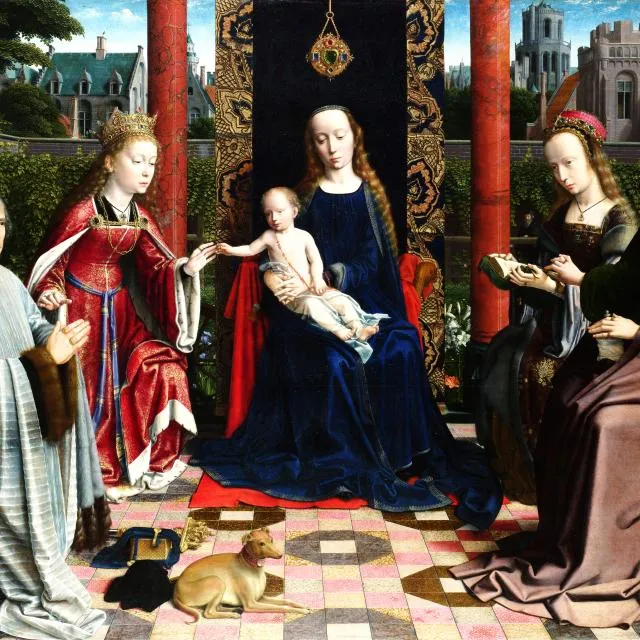
A thin-faced man dressed as a canon (a member of the clergy who is on the staff of a cathedral) kneels in prayer, surrounded by three saints. This is Bernardijn Salviati, illegitimate son of a Florentine merchant, and canon of the Collegiate Church of Saint Donation in Bruges (he died in 1519). The same outfit is worn by his friend and fellow canon, Richard der Capelle, in The Virgin and Child with Saints and Donor.The saints are, from left to right: Martin of Tours, with the beggar he gave his cloak to on the road behind him; the Franciscan Bernardino of Siena, Bernardijn’s name saint, in a grey habit; and Donation, patron saint of Bernardijn’s church. The panel, which originally had an arched top, was almost certainly the left wing of a diptych commissioned for the chapel of Saint John the Baptist and Mary Magdalene at Saint Donation’s, which Bernardijn was given permission to restore in January 1501. The other part of the diptych is probably a scene of the Crucifixion now in the Staatliche Museen, Berlin. On the back of our panel is a ruined picture apparently showing the resurrected Christ at an open window, which would have been visible when the diptych was closed.Bernardijn was the son of Borromeo Salviati, who was from a noble Florentine family and probably the manager of the Bruges branch of the Salviati company in the mid-1460s. His mother Christine was from a well-to-do Flemish family, the van Rossems. Born in the 1460s, Bernardijn trained as a lawyer and worked a good deal for the Italian communities in Bruges. His association with Saint Donation’s church seems to have begun in the late 1480s, and he held a series of positions there, becoming a canon in 1498. He was one of a circle of Italian and Dutch patrons in Bruges, and was a good patron of David’s. He was perhaps instrumental in securing for him the commission for The Virgin and Child with Saints and Donor; he seems to have known the donor personally.Bernardijn seems to have been an endearing character, a generous and humorous man fond of good living. For example, he drew comical musical notation in the church’s minutes relating to a sung mass. At his death he was living with six friends or relatives, and had a good deal of silver, some engraved with his family’s coat of arms, quantities of wine and some expensive clothes. He bequeathed works of art to two women: a statue of Mary Magdalene to the Prioress of the convent of Sion, and a diptych of himself and the Virgin to a widow named Martine (a relationship which perhaps casts light on the otherwise unexplained presence of Saint Martin in our panel). He was also devoted to his mother, and was buried beside her in a tomb for which he had commissioned a brass showing them together.Even his altarpiece might reflect his maternal affection. He clearly had an interest in Saint Mary Magdalene: he owned a statue of her and had the chapel he endowed re-dedicated to her; she is the central figure in the Crucifixion panel in Berlin, and also appears on Saint Martin’s cope in this painting. Could Mary Magdalene, a repentant sinner, have been an inspiration for his unmarried mother, a devotion continued by her son?
47 collected·17 zoomed·0 comments
About this artwork
Canon Bernardijn Salviati and Three Saints (after 1501) by Gerard David, oil on wood, from the National Gallery, London collection.
About Gerard David
Gerard David was the last great 15th-century painter from Bruges working within the tradition of realism founded by van Eyck. A subtle colourist, he succeeds in creating atmosphere through his evocative landscapes.
More by Gerard David
Comments (0)
No comments yet. Be the first to share your thoughts.