

Christ Crowned with Thorns

1480-95 · Tempera on wood
Dimensions 21.6 x 21.6 cm
Collection: National Gallery, London
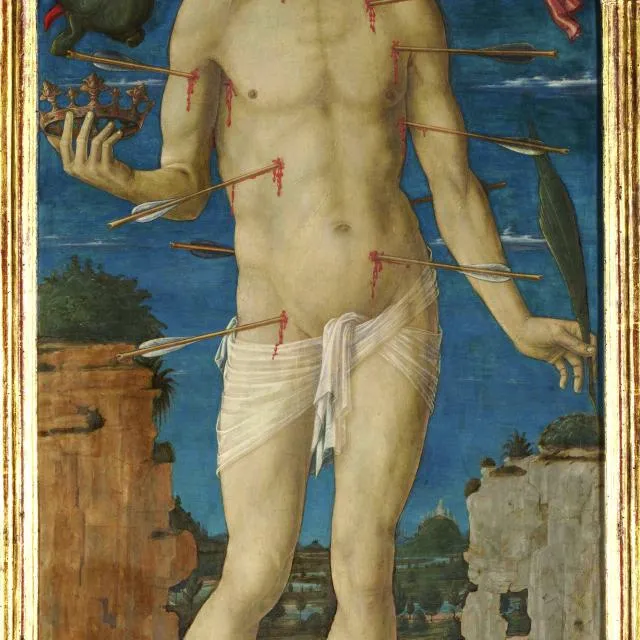
After being condemned to death, Christ was forcibly crowned with a wreath of thorns. This was the Roman soldiers‘ attempt to humiliate him as, amongst other things, Christ was accused of claiming to be ‘the king of the Jews’.Close-up views of Christ in this moment, when he was tortured before the Crucifixion, were very popular in the fifteenth century. They confronted viewers with Christ’s suffering – here, blood dribbles through his hair and down his neck – encouraging their empathy and leading to deeper devotion. The square format of this picture is unusual. The frame is original, and is affixed to the painting; both it and the reverse are painted blood red, a reference to Christ’s torture and crucifixion.The inscription on Christ’s halo – not always included in images like this – is the abbreviated Greek version of Christ’s name, meaning ’Jesus Christ of Nazareth‘. The inscription in Latin around the edges comes from the New Testament book of Philippians (2:10): ’that at the name of Jesus every knee should bow, of things in heaven, and things in earth, and things under the earth'. The same verse is sometimes inscribed on the plaque of Saint Bernardino, a fervent preacher active in Siena in the fifteenth century who promoted devotion to the name of Jesus. The connection is not surprising given that the artist, Matteo di Giovanni, was from Siena.When it was purchased by the Gallery in 1854, the painting was thought to be by the fifteenth-century Umbrian painter, Niccolo di Liberatore, known then as Niccolo di Foligno (Foligno being his hometown). Some years later it was recognised as a work by Matteo, but this idea was rejected when it was cleaned in the mid-twentieth century; it was then suggested that the painting was actually made in modern times. The restorer was sceptical about the picture surface which he noted was ‘unpolished’. The painting’s finish is certainly not glossy, but this matt appearance can be found in the work of other Sienese painters of the period, such as Benvenuto di Giovanni’s Virgin and Child and one of Matteo’s other works in our collection, Saint Sebastian.Technical analysis undertaken in 2009 confirmed that the pigments used are the same as those commonly used in the fifteenth century; the green in the crown of thorns, for example, is made from a particular type of the mineral called malachite, which is also found in many of the Gallery’s fifteenth-century paintings. The underdrawing here, in which strong parallel lines indicate areas in shadow, is very similar to that in other paintings attributed to Matteo. This is particularly evident along the right side of the neck.
53 collected·24 zoomed·0 comments
About this artwork
Christ Crowned with Thorns (1480-95) by Matteo di Giovanni, tempera on wood, from the National Gallery, London collection.
More by Matteo di Giovanni
Comments (0)
No comments yet. Be the first to share your thoughts.