

Christ washing the Feet of the Disciples

about 1575-80 · Oil on canvas
Dimensions 204.5 x 410.2 cm
Collection: National Gallery, London
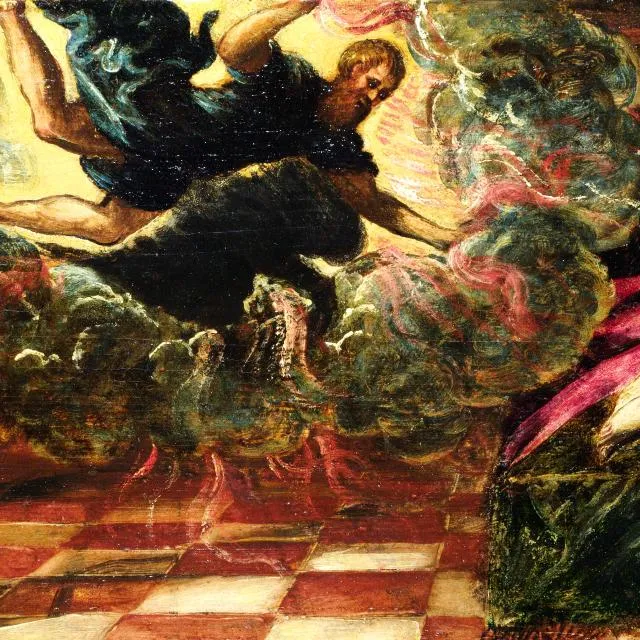
The episode of Christ washing the feet of his disciples is told in the Gospel of John (13:2–17). After supper with his disciples Christ rose and began to wash their feet. Peter said he could not allow this, but Christ replied that if Peter would not allow him to wash his feet then he had no place with him. Peter asked Christ to wash his hands and head as well, but Christ said that those who were clean only needed to have their feet washed. He then instructed the disciples to wash one another’s feet.The painting is first recorded in the chapel of the Most Holy Sacrament in the Church of S. Trovaso in Venice. This chapel was the responsibility of the Scuola di Santissimo Sacramento (Confraternity of the Most Sacred Sacrament) – which is still active in the city today – and they must have commissioned the painting in about 1575–80. It was the confraternity’s responsibility to accompany the Sacrament with a lantern and a bell to the houses of the sick. Tintoretto’s Christ washing the Feet of the Disciples originally hung on the right of the altar and his Last Supper (still in the chapel today) hung on the left.Tintoretto has set the washing of the feet in a large room with a fire beneath a massive hood and a long table at an angle on the left. There are 12 people present excluding the servant woman, who appears from behind the curtain at the back of the room to the left – this means that Judas, who would betray Christ, must have already left. This is unusual: Judas is normally included in paintings of this episode by other artists as well as by Tintoretto. He might have been left out because he was shown leaving the table in The Last Supper, which Tintoretto may have painted first, in about 1563–4.Christ washing the Feet of the Disciples illustrates the need for self-abasement and fraternal love, as well as for purification by Baptism and Penance. Penance was required before receiving communion. The Counter-Reformation Church placed renewed emphasis on the proper preparation for receiving communion, which may explain the popularity of this episode as a subject for chapels of the Sacrament in late sixteenth-century Italy. Such paintings were often commissioned by confraternities, which emphasised charitable acts and duty to one another.Christ washing the Feet of the Disciples is painted on a black ground on which Tintoretto first sketched the composition in white paint. Some of this white brush drawing is now visible on the worn surface of the painting, for example in the legs of the torch-bearing disciple at the front left, in Peter’s shoulder, in the architecture in the background and in the brass basin. In many places the paint has darkened and become translucent, which now makes the blacks more dominant than Tintoretto can have intended. The chequered floor is largely repainted, in a much less subtle manner than that in Tintoretto’s Last Supper, which it probably originally would have resembled.
70 collected·80 zoomed·0 comments
About this artwork
Christ washing the Feet of the Disciples (about 1575-80) by Jacopo Tintoretto, oil on canvas, from the National Gallery, London collection.
More by Jacopo Tintoretto
Comments (0)
No comments yet. Be the first to share your thoughts.