

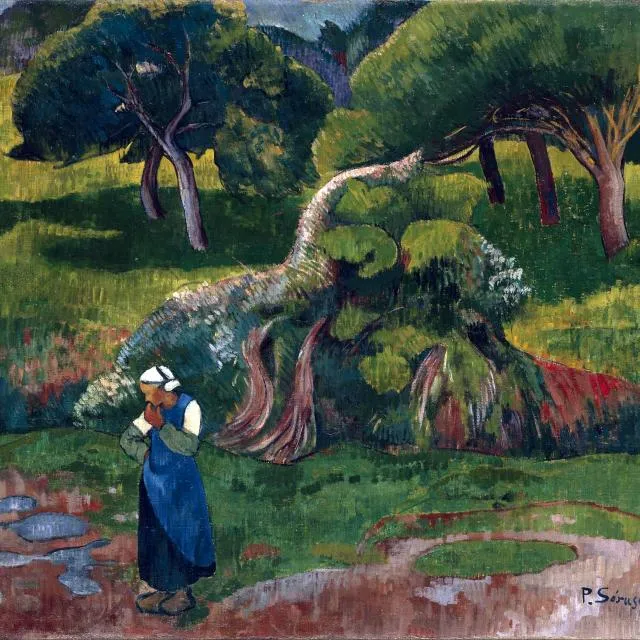
Farmhouse at Le Pouldu

1890 · oil on canvas
Dimensions overall: 72 x 60 cm (28 3/8 x 23 5/8 in.)
Collection: National Gallery of Art
Credit Gift (Partial and Promised) of Alexander M. and Judith W. Laughlin
Paul Sérusier was born in Paris, and signed on as a student at the Académie Julian—the largest private art academy in Paris—in 1884. In the summer and autumn of 1888 he traveled in Britanny, where he visited for several weeks the village of Pont-Aven. At the Pension Gloanec, a gathering place of artists, he came into contact with Paul Gauguin. Gauguin and other painters were attracted by the remoteness of Brittany from the sophisticated art world of Paris, and they admired the relative simplicity of the Breton peasants' rural life, their picturesque regional costumes, and a traditional religious faith seemingly unchanged since medieval times. Sérusier soon became an intimate of the artistic circle around Gauguin, including Emile Bernard and Maurice Denis, who called themselves the Nabis (derived from a Hebrew word for prophet). They did not wish to capture the appearances of nature in a realistic manner, but rather to simplify form and color, and to arrange their sense perceptions into works of art that were decorative objects with a certain autonomy or independent artistic identity. Denis expressed these ideas most radically in his famous statement: "Remember that a painting—before being a war horse, a nude woman, or some anecdote—is essentially a flat surface covered with colors arranged in a certain order." [1]Sérusier's Farmhouse at Le Pouldu is based on his observation of a typical Breton farmhouse, with a woman in local costume crossing the yard. But he has simplified shapes, flattened forms, and reduced the complexities of sunlight and dappled shade to broad areas of color, bounded by clear outlines. This flattening out of forms and the employment of sinuous linear patterns to unify the picture surface was sometimes referred to by the Nabis as "synthetism," denoting the idea of an artificial pictorial unity that sets the work of art apart from mere natural appearances. Sérusier's manner of painting is strongly influenced by Gauguin and Paul Cézanne, notably in the deliberately applied rows of short, finely hatched brushmarks, quite visible in the sky, trees, thatch of the cottage, and the pile of hay. Rather than the conventional pictorial subjects of farmhouse, peasant woman, farmyard, gate, trees, and the fields beyond, it is their decorative organization that forms the true subject of Sérusier's picture.(Text by Philip Conisbee, published in the National Gallery of Art exhibition catalogue, Art for the Nation, 2000)Notes1. Maurice Denis, Définition du néo-traditionnisme, 1890.
127 collected·226 zoomed·2 comments
About this artwork
Farmhouse at Le Pouldu (1890) by Paul Serusier, oil on canvas, from the National Gallery of Art collection.
About Paul Serusier
Paul Sérusier (9 November 1864 – 7 October 1927) was a French painter who was a pioneer of abstract art and an inspiration for the avant-garde Nabis movement, Synthetism and Cloisonnism.
More by Paul Serusier
Comments (0)
No comments yet. Be the first to share your thoughts.