

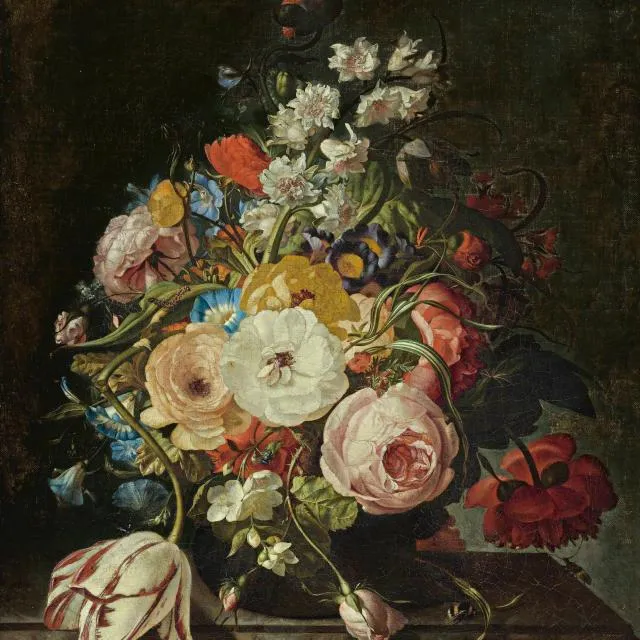
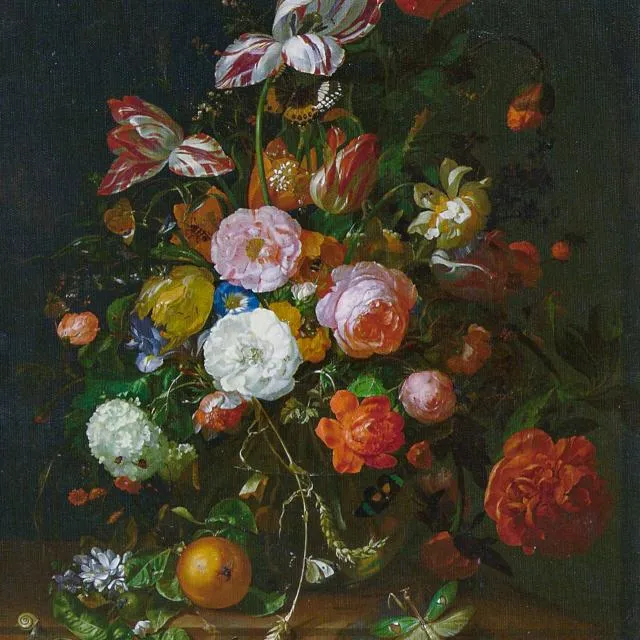
Flowers in a Vase

about 1685 · Oil on canvas
Dimensions 57 x 43.5 cm
Collection: National Gallery, London
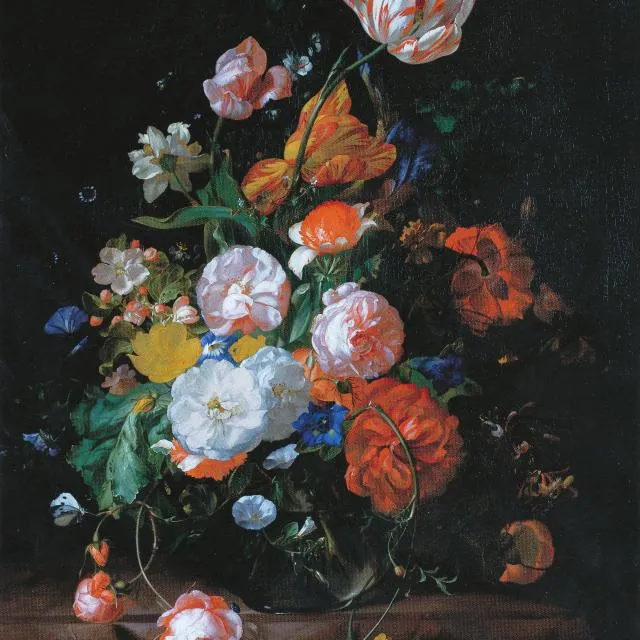
Rachel Ruysch’s elegant bouquet carries with it a breath of autumn. Pear blossom, peonies, viburnum, honeysuckle and columbine all bloom early in the year. But the burnt orange, russet and deep green of the Martagon lilies, the seed pod straggling over the edge of the stone shelf, the ripe wheat, and crisp, veined leaves near the end of their life turn away thoughts of spring.The light on the pale flowers sweeps upwards, making them luminous. Overhead, Ruysch’s delicate brushstrokes seem to skim over the surface of the picture, so that the dusky blue columbine seem as if they‘re drifting in the darkness. The plump green pistil at the centre of the large peony appears to anchor the flower as if to prevent it floating away upwards on the line of the wheat stem above. The honeysuckle hardly touches the stone shelf, and from a short distance the pear blossom becomes a series of white dots scattered against the black wall.In spite of the apparent weightlessness of each bloom, Ruysch builds her painting on a series of strong lines slightly tipped on the diagonal. The first drops down from the columbine, through the snowball viburnum and the peony, to the grasshopper almost hidden by the honeysuckle. Another starts at the pear blossom and leads across to the crimson peony bud almost lost in the shadows. The many diagonals that cross the painting, together with the strong contrasts in light and colour, underpin Ruysch’s design, allowing her the freedom to make her flowers light and ephemeral without losing depth and form.Ruysch was one of the most successful flower painters of the late seventeenth and early eighteenth century. Her father was a botanist, anatomist and keeper of Amsterdam’s botanical garden – an important centre of the booming horticultural industry of the time, and a place of experiment. She had first-hand knowledge of the things she painted, from specimen blooms and new floral imports to the tiny ants, the grasshopper and acrobatic caterpillars busy among them.So why did she do what almost every other flower painter of the time did – show flowers that couldn’t be in bloom at the same time in a vase together, and how did she do it? She, as they all did, stored detailed sketches and drawings made when each flower was in bloom, and put them together in the finished image. But why is less clear – why not paint a picture of flowers in season?There may be no definite answer. Perhaps it was a tradition that grew up gradually. Perhaps it was a matter of taste – choosing flowers the artist or the client liked best. Perhaps it was an aesthetic need for different shapes, colours and textures only made possible by mixing flowers from the different seasons.But the strong juxtaposition of spring, summer and autumn in Ruysch’s painting, and the fleeting impression she gives to the flowers, may suggest another reason. Perhaps the idea was simply to present the passing of the richness and diversity of each season as whole. The owner could explore the wonders of nature and science – which at that time preoccupied many people and which, in a deeply religious, Protestant country, many thought of as a gift from God.
167 collected·190 zoomed·0 comments·1 boards
This artwork is in 1 board
About this artwork
Flowers in a Vase (about 1685) by Rachel Ruysch, oil on canvas, from the National Gallery, London collection.
About Rachel Ruysch
Rachel Ruysch (The Hague, 3 June 1664 – Amsterdam, 12 October 1750) was a still-life painter from the Northern Netherlands. She specialized in flowers, inventing her own style and achieving international fame in her lifetime.
More by Rachel Ruysch
Comments (0)
No comments yet. Be the first to share your thoughts.