

Fruit, Flowers and a Fish

1772 · Oil on mahogany
Dimensions 72.2 x 56.7 cm
Collection: National Gallery, London
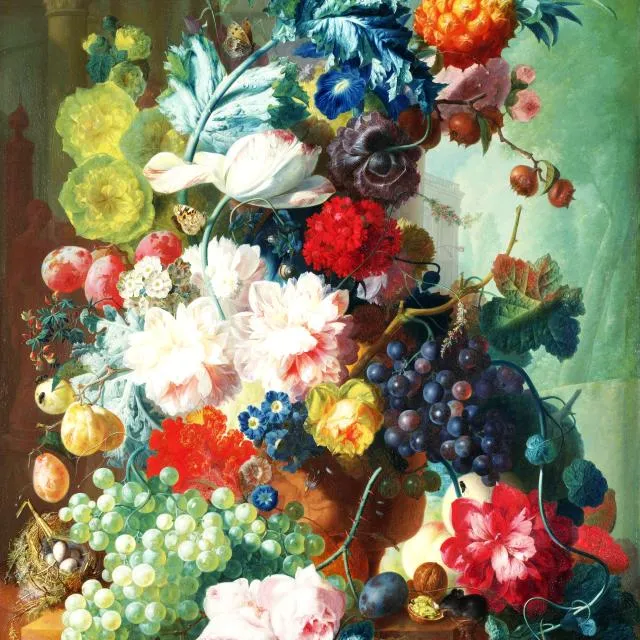
This extravagant celebration of textures, scents and tastes is far more than a naturalistic study. It’s high artifice – a picture of pure luxury. It’s as if Jan van Os has laid every object down flat to arrange them and then lifted the composition, as if by magic, into a position that defies reality. In fact, it never was a reality. Van Os would probably have drawn his ideal arrangement and painted each element from sketches and drawings. And yet everything appears real, as if you could touch it. It’s as if the white rose were bending over to take in every detail of the pink flesh of the cut melon. Seen close up, the artist makes a whirling abstract image of the rind of the neighbouring fruit.Van Os has savoured the skin, flesh and form of each fruit as if it is a precious thing – which, in terms of cost, it was. Almost every fruit he shows was, in the early eighteenth century, a rare sub-tropical phenomenon grown against the laws of nature in a cool, damp European country. This was only made possible by the recent invention of the hothouse, and to own one required a lot of money. The first hothouses were hit-and-miss affairs where heating broke down easily. The first recognisable modern hothouse is traditionally said to have been built at Leiden, not far from the Hague where van Os lived.Grapes of every colour, white and purple plums and the rich scarlet of the redcurrants glisten against dark leaves. But these fruits aren't perfect: some are past their best or simply blemished. In the days before refrigeration, this would have been expected – and acceptable – in a picture. Like the fly, its transparent wings outlined on the peach, and the butterfly, tiptoeing delicately on a wheat stem, they may be symbols of the transience of life.The flowers were equally valued. In the eighteenth century, the Dutch continued to breed complex, many petalled and highly scented roses. The artful placing of two tall hollyhocks – also great garden favourites – at the back of the bouquet continues the arrangement’s upward thrust but also gives it a more three-dimensional look. They also draw the eye to the elegant, pale green garden background.Whether intentionally or not, the picture is as much a celebration of science – horticulture and the use of microscopes to look at insects in detail – as it is of nature. But it’s possible that it also hints at religious faith. The pomegranate, cut open to reveal its red seeds, is traditionally a symbol of Christ’s resurrection. Van Os has left empty spaces where seeds have perhaps been eaten, maybe even by the mouse sniffing bright-eyed at the walnut way below. Next to it is a fish, prepared for cooking on a pewter plate. Fish were sometimes a symbol of Christ and might be recognised as such in a devoutly Christian country, where thanks were regularly given for the bounties of nature.
91 collected·83 zoomed·0 comments·1 boards
This artwork is in 1 board
About this artwork
Fruit, Flowers and a Fish (1772) by Jan van Os, oil on mahogany, from the National Gallery, London collection.
More by Jan van Os
Comments (0)
No comments yet. Be the first to share your thoughts.