

Head of a Peasant Woman
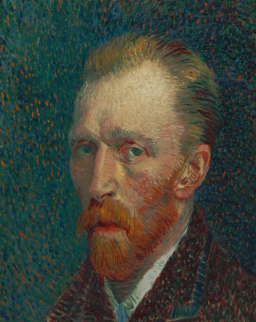
about 1884 · Oil on canvas
Dimensions 40.3 x 30.5 cm
Collection: National Gallery, London
In late 1883, just one year after launching his career as a professional artist with a commission from his uncle for two sets of drawings of The Hague, Van Gogh moved to the town of Nuenen in North Brabant, a province in the south of the Netherlands. His arrival there marked the beginning of a highly productive period that was to culminate in his first major painting, The Potato Eaters (Van Gogh Museum, Amsterdam). Completed in May 1885, this was an ambitious picture in which Van Gogh sought to create an image of modern rural life that had the monumentality of history painting.Writing to his brother Theo about the drawings he had made for their uncle, Van Gogh said: ‘I have tried to draw things as naively as possible, exactly as I saw them before me.’ This commitment to authenticity can also be seen in Head of a Peasant Woman. It belongs to a group of around 40 portraits of the local peasantry that Van Gogh painted directly from life during the winter of 1884–5. In a letter written in July 1884, Van Gogh stated that he was looking for models whose features included rough, flat faces and low foreheads, not ’sharp, but full and Millet-like‘. His sitters included men and women, young and old, but all the portraits have a similar format. Each shows the head from the shoulders up, either frontal or in profile, set against a dark background from which the face emerges. All the sitters are wearing their working clothes, such as the dark bonnet and jacket depicted here.Van Gogh’s peasant portraits are often characterised by their deliberately crude brushwork and sombre colours. He compared his sitters to the earth they dug, ’something like the colour of a really dusty potato, unpeeled of course’. Unlike the deep black shadows and exaggerated facial features in The Potato Eaters, this portrait has a lightness to it and the brushwork is less coarse. It shows a young woman with large dark eyes and an evenly lit face that is broad and open. Although she has strong features, the outlines of her face are rounded rather than angular, and her expression is wistful, even sad. More than just a stock type, she is perhaps an individual with whom Van Gogh felt some rapport.Acquired by the National Gallery in 2013, this is the only portrait by Van Gogh in the collection and the only example of his early, Dutch period before he moved from Holland to France. It complements the Gallery’s four other Van Gogh paintings, which date from the final two years of his life, when he lived in Arles and Saint-Rémy in the south of France.
152 collected·177 zoomed·0 comments·2 boards
This artwork is in 2 boards
About this artwork
Head of a Peasant Woman (about 1884) by Vincent van Gogh, oil on canvas, from the National Gallery, London collection.
About Vincent van Gogh
Vincent Van Gogh was born on 30 March 1853 in Zundert in the southern Netherlands, the son of a pastor. In 1869, he took his first job, working in the Hague branch of an international art dealing firm. He began to write to his younger brother Theo, a correspondence which continued for the rest of Van Gogh's life.
More by Vincent van Gogh
Comments (0)
No comments yet. Be the first to share your thoughts.