

L'Hôpital-Camfrout, Brittany

about 1870-2 · Oil on wood
Dimensions 20.3 x 39.4 cm
Collection: National Gallery, London
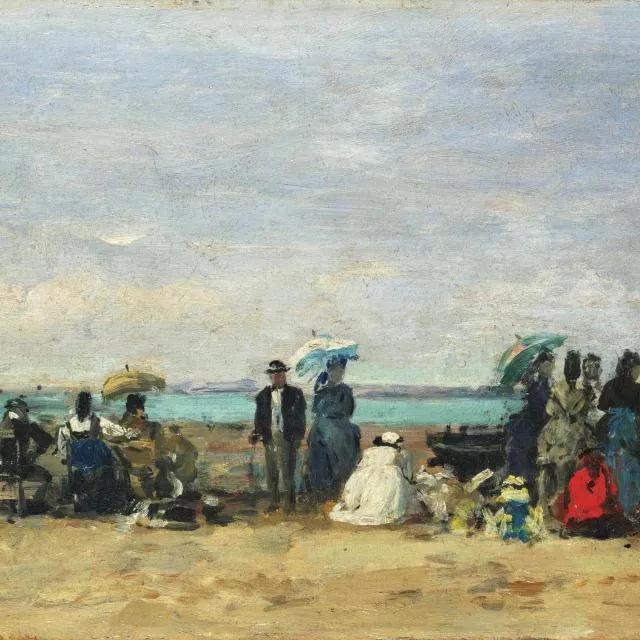
Boudin was born and brought up on the Normandy coast, retaining a lifelong affection for the area, which he painted throughout his career. But he was also drawn to Brittany, and made regular visits there in the 1850s, 1860s and 1870s, marrying a Breton woman, Marie-Anne Guėdès in 1863. His first paintings of the region reflected his fascination with its weddings and folk customs, such as pardons (religious festivals), that were widely regarded as ‘exotic’ and had already appeared in paintings by other artists, such as Pierre-Charles Poussin’s Pardon Day in Brittany (1851). This phase in Boudin’s work culminated in The Pardon of Ste-Anne-La-Palud (Museum of Modern Art, Andrė Malraux, Le Havre), a crowded figure scene of people on a religious pilgrimage full of anecdotal episode which he exhibited at the Salon in 1859.This painting of Hôpital-Camfrout, however, is devoid of such colourful folkloric detail. It is an overcast day in the small market town in western Brittany that takes its name from a medieval hospital on the pilgrim route to Santiago da Compostela. On a confluence of two rivers near the coast, it was a town Boudin knew well, as it was close to the home of his in-laws. The scene is almost deserted, although some people are rowing across the water and a few dabs of paint suggest activity on the shore. In the background is the spire of the town’s most prominent landmark, the church of Notre Dame de Bonne Nouvelle.Boudin’s palette is almost monochome, dominated by the blue-greys that reflect the town’s granite buildings with their slate roofs, relieved by touches of white and a slash of red on the boat in the foreground. With its remarkably free handling of paint, this modest panel has the air of having been painted on the spot. It is a far cry from the beach scenes of Trouville peopled with fashionably dressed holidaymakers such as Beach Scene, Trouville, for which Boudin is best known. Perhaps it is no accident that a visit to Brittany in 1867 was a catalyst that eventually led to a change of artistic direction. Observing the hard and simple life of the Bretons made Boudin begin to question his practice of painting well-to-do visitors idling on the sands.
52 collected·37 zoomed·0 comments·1 boards
This artwork is in 1 board
About this artwork
L'Hôpital-Camfrout, Brittany (about 1870-2) by Eugene Boudin, oil on wood, from the National Gallery, London collection.
About Eugene Boudin
Eugène Louis Boudin (French: [budɛ̃]; 12 July 1824 – 8 August 1898) was one of the first French landscape painters to paint outdoors. Boudin was a marine painter, and expert in the rendering of all that goes upon the sea and along its shores.
More by Eugene Boudin
Comments (0)
No comments yet. Be the first to share your thoughts.