

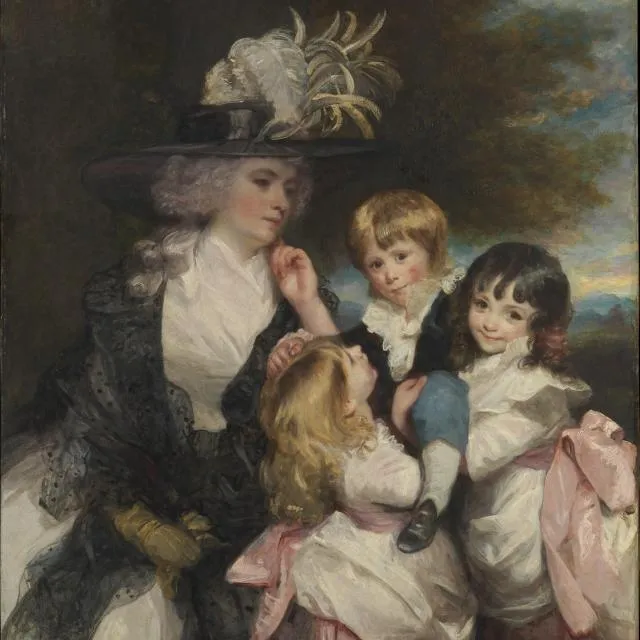
Lady Cockburn and her Three Eldest Sons

1773 · Oil on canvas
Dimensions 141.5 x 113 cm
Collection: National Gallery, London
This portrait of Augusta Anne, Lady Cockburn (1749–1837) with her three energetic infant boys was commissioned by her husband and is based on traditional pictures of Charity, one of the three theological virtues. Charity is often shown as a mother selflessly caring for her children. Although Reynolds’s composition is largely based on Van Dyck’s Charity of 1627–8, he has not simply copied the picture but adopted and adapted elements from it and various other sources.James (1771–1852), the child kneeling on Lady Cockburn’s lap, is an almost direct copy of Cupid in Velázquez’s The Toilet of Venus. Reynolds could only have known Velázquez’s picture from a pencil drawing by the engraver Richard Cooper, as the original painting was in Madrid and had never been engraved. Reynolds often ‘invented’ new pictures from a variety of undisclosed artistic sources. He believed it was perfectly valid to borrow ‘a particular thought, an action, attitude or figure’ and transplant it into his own work.Reynolds made a small incomplete oil sketch of the upper part of Van Dyck’s Charity from an engraving in which the original image is reversed. He probably didn’t make the little oil sketch for this portrait, but just to help him remember Van Dyck’s composition – he had a vast collection of prints which served as a mine for ideas. Indeed, Reynolds does not appear to have made any figure studies specifically for this portrait.The commission in 1773 to paint Lady Cockburn with her three sons, all under three years old, gave Reynolds the idea of adapting Van Dyck’s allegory of Charity to a contemporary portrait group, combining the portrait of an individual with the personification of a virtue. Lady Cockburn’s hair is dressed in contemporary fashion and she is preoccupied with the care of her children. She holds baby William (1773–1858) in a position to be nursed, although her breast is modestly covered. George (1772–1853) leans over his mother’s shoulder and looks at us as though about to suck his thumb, while Lady Cockburn gazes distractedly at James, who points upward. The brightly coloured macaw, painted from life, is probably Reynolds’s own bird, hated by his housemaid but reportedly tame enough to perch on the wrist of his friend, Dr Johnson.The painting is inscribed ‘J REYNOLDS:PINX’ in gold in the lower centre, above the fur-trimmed edge of Lady Cockburn’s mantle, and ‘1773’ in gold at the lower left. Most of the lighter paint has wrinkled, particularly in Lady Cockburn’s costume, in her left hand and in the flesh of the eldest and youngest of the three children.According to one report, when the picture arrived at the Royal Academy for exhibition in 1774, ‘all the painters then present were so struck with its extraordinary splendour and excellence’ that they suddenly clapped their hands. The portrait was commissioned when the family was doing well financially, but by 1781 Lord Cockburn was declared bankrupt and in her distress Lady Cockburn was granted a private pension by King George III. In 1791, 18 years after the painting had been exhibited at the Royal Academy, it was engraved as Cornelia and her Children. The title referred to a famous anecdote from Roman history: Cornelia, a highly educated aristocratic woman, mother of Tiberius and Gaius Gracchus, did not wear jewellery but called her children her ‘jewels’.
62 collected·60 zoomed·0 comments
About this artwork
Lady Cockburn and her Three Eldest Sons (1773) by Sir Joshua Reynolds, oil on canvas, from the National Gallery, London collection.
About Sir Joshua Reynolds
Sir Joshua Reynolds PRA FRS FRSA (16 July 1723 – 23 February 1792) was an English painter, specialising in portraits. John Russell said he was one of the major European painters of the 18th century. He promoted the "Grand Style" in painting which depended on idealization of the imperfect.
More by Sir Joshua Reynolds
Comments (0)
No comments yet. Be the first to share your thoughts.