

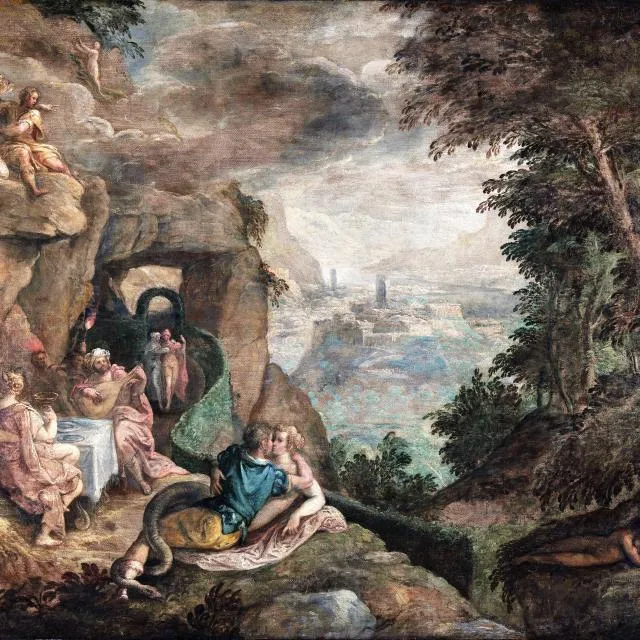
Landscape with the Expulsion of the Harpies

about 1590 · Oil on canvas
Dimensions 185 x 206 cm
Collection: National Gallery, London
As punishment for revealing the future to mankind, King Phineas of Thrace was blinded, suffered the sorrows and pains of old age and had his food continually stolen and spoilt by the harpies. Half human and half bird, the harpies were the spirits of sharp gusts of wind. Because Phineas could see the future, he knew that his brothers-in-law Zetes and Calais, who were both travelling with the Greek hero Jason on his ship the Argo, were destined to deliver him from the harpies.A naked woman points to the sky as Zetes and Calais, the winged sons of Boreas, the god of the north wind, put down food as bait to catch the harpies. King Phineas stands to the right, beside the female figure of Fortune, pointing upward as two young Boreads launch themselves into the air to do battle with the dragon-like creatures circling in the clouds. A third winged figure, wearing a lion skin, swoops down from the top.The story is told in the Argonautica, an epic romance written by Apollonius Rhodius during the third century BC. It also appears in Virgil’s Aeneid (Book III) and Ariosto’s Orlando Furioso (Cantos 33 and 34). Iris, the wife of Zephyrus, the god of the west wind, persuades the sons of Boreas not to kill the harpies in return for a promise from them that they would never return. King Phineas then tells Jason and the Argonauts how to continue safely on their journey. Paolo Fiammingo’s Landscape with a Scene of Enchantment may show Odysseus and his men delayed from their journey on the enchantress Circe’s island.Both canvases may once have been part of a larger series of perhaps six or more paintings. They are very large – over two metres wide and almost two metres high – and were probably made to decorate a Venetian palace, possibly the Palazzo Vendramin on the Grand Canal. Such a series of paintings would have decorated the upper walls of a whole room, like wallpaper today. When decorating walls elsewhere in Italy, it was usual to paint directly on the plaster, a technique known as fresco. However fresco was not suited to the damp climate of Venice, and so large canvases like these were painted instead. These pictures were painted exceptionally hastily using only a limited range of colours, probably because they were intended as interior decoration rather than as gallery paintings.The pigment smalt, used for the blue of the sky, has discoloured and turned a greenish-grey, and some of the green foliage has darkened. The paint may have been prepared quickly or without proper care. There are also many pentimenti – areas in which Paolo Fiammingo painted over parts of the composition when he changed his mind. The number of these changes also suggest that he was painting quickly without much initial planning.
162 collected·306 zoomed·0 comments
About this artwork
Landscape with the Expulsion of the Harpies (about 1590) by Paolo Fiammingo, oil on canvas, from the National Gallery, London collection.
More by Paolo Fiammingo
Comments (0)
No comments yet. Be the first to share your thoughts.