

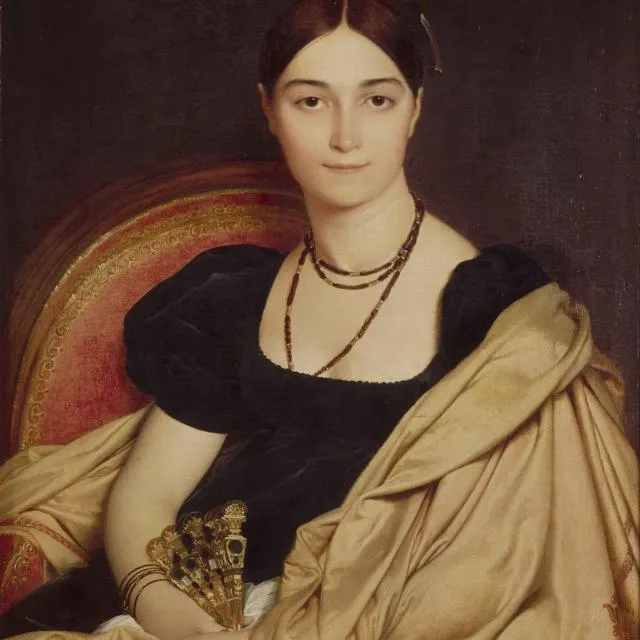
Madame Moitessier

1856 · oil on canvas
Dimensions (92.1 x 120 cm)
Collection: National Gallery, London
Marie-Clotilde-Inès de Foucauld was born in 1821 and married Sigisbert Moitessier, a wealthy banker, in 1842. The portrait is influenced by the art of antiquity and the Renaissance. The pose, with the hand touching the cheek, is derived from an ancient Roman fresco of a goddess, from Herculaneum. This may suggest that for Ingres Madame Moitessier represented the ideal of classical beauty. Ingres believed that portraiture was a less elevated art form than history painting. When first asked by Moitessier in 1844 to paint his wife, Ingres refused. On meeting her he was struck by her beauty and agreed. The picture was left unfinished and after seven years the sitter complained. In 1851, Ingres painted a standing portrait before returning to the seated portrait which he finally completed in 1856. The original intention had been to include the sitter's daughter Catherine, but she had grown up by the time Ingres came to complete the portrait.
206 collected·437 zoomed·1 comments
About this artwork
Madame Moitessier (1856) by Jean Auguste Dominique Ingres, oil on canvas, from the National Gallery, London collection.
About Jean Auguste Dominique Ingres
Jean-Auguste-Dominique Ingres (29 August 1780 – 14 January 1867) was a French Neoclassical painter. Ingres was profoundly influenced by past artistic traditions and aspired to become the guardian of academic orthodoxy against the ascendant Romantic style.
More by Jean Auguste Dominique Ingres
Comments (0)
No comments yet. Be the first to share your thoughts.