

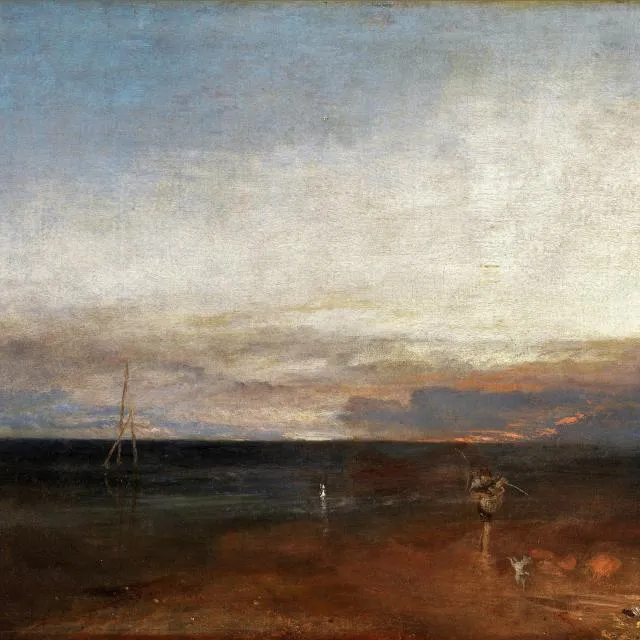
Margate (?), from the Sea

about 1835-40 · Oil on canvas
Dimensions 91.2 x 122.2 cm
Collection: National Gallery, London
As with many of Turner’s paintings that were never exhibited in his lifetime the title of this picture was not his choice. Instead, it was decided on some 50 years later when an inventory was being made of the Turner Bequest (the gift of his paintings he left to the nation in his will).We can’t be sure that it shows the north Kent seaside town of Margate, but the white cliffs just visible on the horizon recall other views of Margate by Turner. He first came to Margate aged 11, when his parents sent him to a school in the old town. He returned ten years later to sketch, and from the 1820s became a regular visitor, finding refuge there from London. In 1833 he began a relationship with the twice-widowed Sophia Booth, living in her house, which had magnificent views over Margate harbour. Although Turner and Mrs Booth also lived together in Chelsea, he continued to travel regularly on the steamboat between London and Margate until the year before his death. As Margate had also been the starting point for many of Turner’s trips to Europe, he was very familiar with views of it from the open sea.This painting belongs to group of around 20 late sea-paintings from the Turner Bequest, together with several others not in the Bequest, which Turner did not exhibit. These pictures are difficult to date precisely, but the majority, perhaps all, were painted between 1835 and 1845. As here, many of these pictures have a relatively low horizon created by a line of breaking waves or just a hint of distant shoreline. Whether this picture is of Margate is not that important, as the distance from the shore and the weather conditions would have made a detailed study of the buildings impossible.Instead, the painting is a fine example of Turner’s lifelong preoccupation with the changing character of the sky and the sea. Around one third of Turner’s oil paintings are maritime pieces, and from the mid-1820s until his death he painted more sea subjects than any other. But although the sea always had powerful symbolic associations for Turner, these late paintings remain grounded in observation rather than imagination. In particular, Turner was interested in the power of the wind to stir up the waves. If this painting is the record of a storm, it is passing and blue sky is now appearing.Although Turner was painting sky and sea, the paint has an almost sculptural quality, especially the use of clotted impasto. You can see this distinctly in the way Turner built up the clouds and used a thin slab of thickly applied white paint to suggest white cliffs on the central horizon. Turner also used a variety of brushstrokes, which in some areas look like scratches, to recreate the choppiness of the waves and the wisps of spray. Scale is ambiguous and objects hard to identify. A curled shape in the lower right corner may be a boat’s sail, but we can't be sure.
138 collected·185 zoomed·0 comments
About this artwork
Margate (?), from the Sea (about 1835-40) by Joseph Mallord William Turner, oil on canvas, from the National Gallery, London collection.
About Joseph Mallord William Turner
Joseph Mallord William Turner RA (23 April 1775 – 19 December 1851), known contemporarily as William Turner, was an English Romantic painter, printmaker and watercolourist. He is known for his expressive colourisations, imaginative landscapes and turbulent, often violent marine paintings.
More by Joseph Mallord William Turner
Comments (0)
No comments yet. Be the first to share your thoughts.