

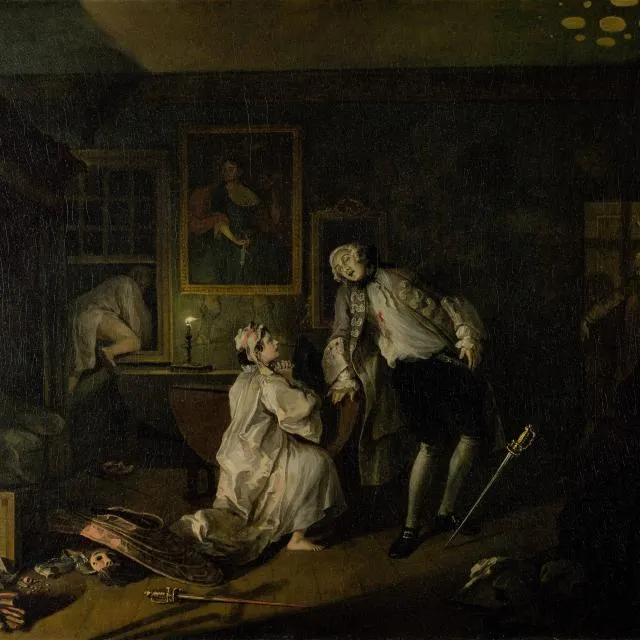
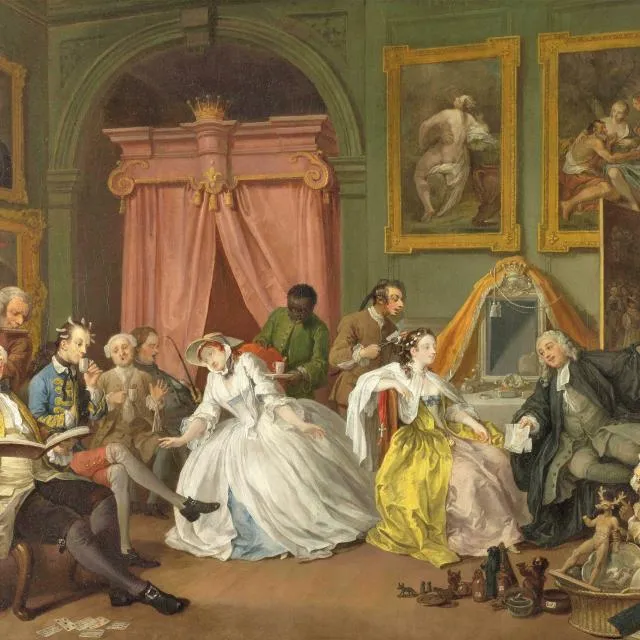
Marriage A-la-Mode: 6, The Lady's Death

about 1743 · Oil on canvas
Dimensions 69.9 x 90.8 cm
Collection: National Gallery, London
This is the final scene of Hogarth’s series of six paintings, Marriage A-la-Mode. The wretched Countess, dogged by the scandal following Silvertongue’s arrest, trial and sentence to death for the murder of her husband the Earl, has returned to her penny-pinching father’s house in the City of London, overlooking old London Bridge. A newly printed broadsheet with the words ‘Counseller Silvertou.../last dying speech...’ lies at her feet. On it is an image of the three-sided gallows at Tyburn – foreshadowed by the tripod in the third scene – where Silvertongue has been hanged by the neck.Her lover dead, the Countess has drunk laudanum – probably the entire contents of the bottle now lying empty on the floor. An old nurse lifts the Countess’s child to kiss his or her mother goodbye (it was common at the time to dress boys in skirts until they were about eight years old). It’s all too clear that the child has congenital syphilis to an advanced degree, as indicated by the black spot on its cheek and sunken bridge of its nose. Its legs are also deformed by the disease and encased in surgical boots and braces. This group of mother, nurse and child parodies the final scene in many a novel of virtue rewarded, above all of Samuel Richardson’s Pamela, which Hogarth had been invited to illustrate. The Countess’s child is unlikely to live long, bringing to an abrupt end the family tree so proudly displayed by the Earl of Squander in the first scene.Suicide was a crime in England until 1961, and a suicide’s possessions had to be given up to the Crown until 1822 – the Alderman prudently removes a ring from his daughter’s finger rather than troubling himself to say goodbye to her as she takes her final breaths. In grabbing her arm, he prevents his daughter from returning her own child’s embrace. He is dressed as he was in the first scene; he is a man of neither fashion nor taste. The pictures in his house are all of Dutch low-life scenes with broad bourgeois jokes.The table is set for a meagre meal: a boiled egg sits upright on a plate of rice; the starved dog gnaws at the ear of the pig’s head which, with its upturned nose and gaping mouth, echoes the expression of the dying Countess. The silver punch bowl on the table – probably presented to the Alderman after a period of office rather than bought – is the only luxury item in the room. The still life on the cloth-covered table may be a deliberate parody of Chardin’s work, which Hogarth may have seen in Paris.The apothecary, who wears a posy in his buttonhole, appears to have a stomach pump and bottle of syrup in the pocket of his black coat. He is making a great show of accusing the half-witted servant of procuring the Countess’s bottle of laudanum, but he may have been treating the Countess himself with it and now fears blame because she has drunk the lot.The doctor wanders out behind the Alderman – there is nothing more he can do. He appears to admire the whole row of fire buckets hanging on the wall in the hallway, each lettered with ’s‘ for sand. The Alderman, unlike his dying daughter, never starts a fire he can’t extinguish.
50 collected·44 zoomed·0 comments
About this artwork
Marriage A-la-Mode: 6, The Lady's Death (about 1743) by William Hogarth, oil on canvas, from the National Gallery, London collection.
About William Hogarth
William Hogarth FRSA was an English painter, printmaker, pictorial satirist, social critic, and editorial cartoonist.
More by William Hogarth
Comments (0)
No comments yet. Be the first to share your thoughts.