

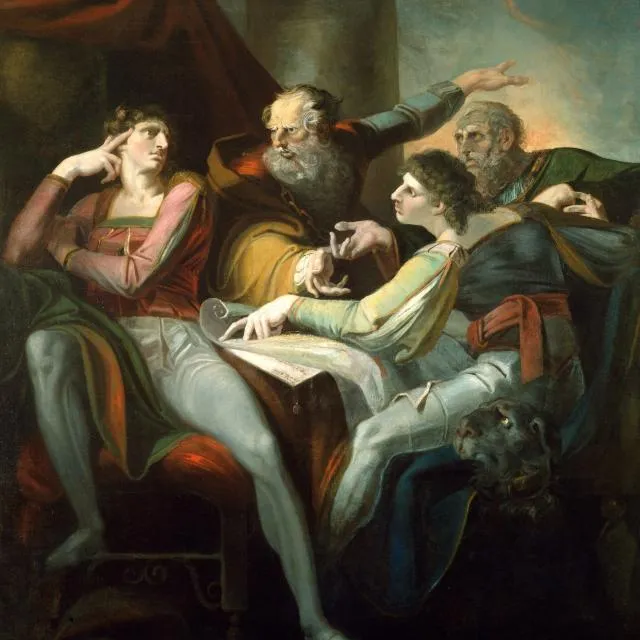
Oedipus Cursing His Son, Polynices

1786 · oil on canvas
Dimensions overall: 149.8 x 165.4 cm (59 x 65 1/8 in.)
Collection: National Gallery of Art
Credit Paul Mellon Collection
Fuseli, a native of Switzerland, began his career in England as a history painter. He developed an expressionistic style composed of a unique blend of influences—German romanticism, the monumental vision of Michelangelo, and the physical and psychological exaggerations of the 16th–century Italian mannerists.Fuseli's own pessimism and fascination with the extremes of human passion are evident. He heightened the intensity of this scene from Sophocles' Oedipus at Colonus by placing Oedipus and his children in a dark, shallow space. The tragedy of the father's curse is played out through the gestures of the four figures. Polynices, who had expelled his blind father from Thebes and left him to live as a beggar, has come to ask his father's support in overthrowing his brother. Oedipus, enraged at his son's request, stretches out his accusing arms and levies his dreadful curse, by which each son would die at the hands of the other. Ismene, weak and despairing, kneels with her head on her father's knee. Antigone, whose strength and determination have kept her father alive, is highlighted above the terrible drama as she reaches out to protect her brother with one hand and restrain Oedipus with the other. Her gesture, however heroic, is futile.
449 collected·808 zoomed·7 comments
About this artwork
Oedipus Cursing His Son, Polynices (1786) by Henry Fuseli, oil on canvas, from the National Gallery of Art collection.
About Henry Fuseli
Henry Fuseli RA (7 February 1741 – 17 April 1825) was a Swiss painter, draughtsman and writer on art who spent much of his life in Britain. Many of his works, such as The Nightmare, deal with supernatural subject-matter. He painted works for John Boydell's Shakespeare Gallery, and created his own "Milton Gallery".
More by Henry Fuseli
Comments (0)
No comments yet. Be the first to share your thoughts.