

Orpheus
1628 · Oil on oak
Dimensions 53 x 81.5 cm
Collection: National Gallery, London
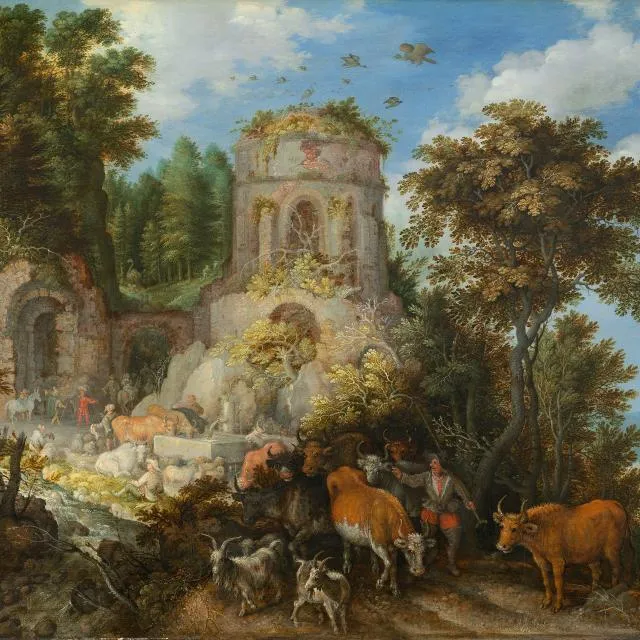
There’s something magical about this enchanting picture, in its unearthly, misty colours, deep shadows, strange beasts. The musician fixing us with an enquiring eye is Orpheus. His story comes from one of the legends told by the Roman poet Ovid in his book Metamorphoses. In it, Orpheus plays the lyre, but for some reason Savery has chosen to show him with a violin.Orpheus' skill was so great that all the beasts of the field and the birds of the air came to hear him play. Even the gods themselves listened, beguiled, and the poet tells how the trees moved from the forests to hear him, and to give him shade.Rather than with music, Savery beguiles us with the animals he paints. Close to Orpheus a cockerel perches on a branch that’s almost touching a lion and a lioness. But they have no eyes for him, or for the grey-feathered pelican at Orpheus’ side, his glittering eye half closed as if in a dream. Behind them a buffalo turns towards the music, startling a stag. An ostrich cranes from the bushes.In Savery’s idyllic landscape – part realistic, part otherworldly – ducks and geese and swans splash in a little stream. Above them, a magnificent horse and a camel look out at a gleaming white elephant. A stately crane displays its feathered crown where the stream tumbles down as a waterfall. A fox lies near peaceful deer and comfortable cows. A wild boar noses in the bushes and a wolf sniffs the air next to another camel. Overhead the birds gather: a skein of geese, a gaudy parrot, long-legged storks. Orpheus’ music isn’t the only sound in the picture – the animals, the rushing stream, the wind in the trees, make a counterpoint.Savery had lived for a while at the court of the Emperor Rudolf II in Prague where he drew the animals in the imperial menagerie, building up a stock of delicate, realistic studies. He made much use of them in the many pictures he painted of the Greek and Roman gods, goddesses and heroes, whose stories were so well loved in his day. He was also living when the Netherlands were under Spanish rule and had been fighting for independence for a long time. Savery’s picture may have been a disguised plea for peace: animals usually hostile to each other, living harmoniously under the influence of Orpheus’ music.
78 collected·80 zoomed·0 comments
About this artwork
Orpheus (1628) by Roelandt Savery, oil on oak, from the National Gallery, London collection.
About Roelandt Savery
Roelant Savery (or Roeland(t) Maertensz Saverij, or de Savery, or many variants; 1576 – buried 25 February 1639) was a Flanders-born Dutch Golden Age painter.
More by Roelandt Savery
Comments (0)
No comments yet. Be the first to share your thoughts.