

Peasants with Mules and Oxen on a Track near a River

about 1641-3 · Oil on copper
Dimensions 39.6 x 58.1 cm
Collection: National Gallery, London
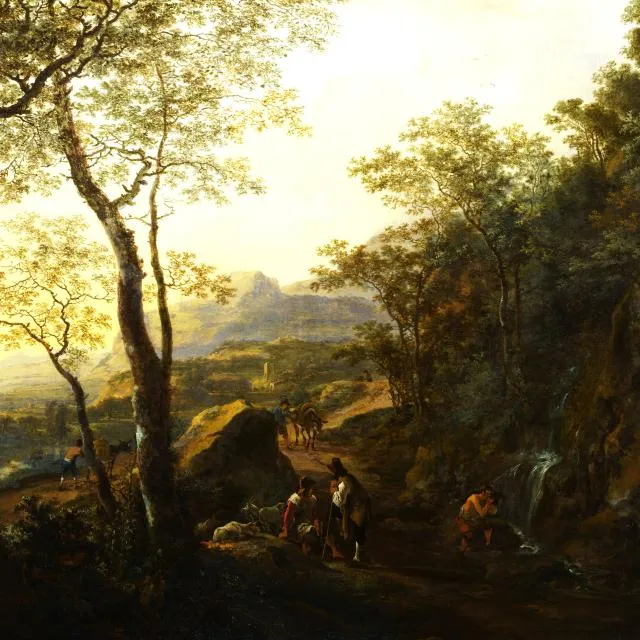
The sun sinks behind a steep Italian hillside, casting a soft, gold light over a meandering river in the valley below. The distant mountains have become so misty they might be mistaken for clouds. But the chill of evening is perhaps settling in. Huddled in his coat with a blanket wrapped round him, his hat well down over his ears, a man rides his mule side-saddle.This is a muleteer, someone who travelled the countryside delivering goods for sale. His water bottle is slung beside his animal’s head. On either side of the front mule’s wooden saddle hang two large barrels that probably carry oil or wine. Each of the thin, patient animals has a decorative feeding bag, so that its nose is constantly dipped into it. The leading mule has a gilt medallion on its forehead. There is a sense of the sun having soaked into the earth and of its effect on man and animals, tired now and moving slower and slower. There’s also a sense of the continuity of rural occupations from ancient times, and of tradition, like the ornamentation of the mules.Behind them – perhaps going a little faster – a peasant drives two oxen down the mountain path. His raises his hand as if his attention has been caught by something high up in the woods, a bird or small creature perhaps. The scene is saved from becoming too idyllic by a leafless tree at the side of the path making harsh angular shapes at variance with the soft, fine leaves of the beech trees. The undergrowth is thick. Here, as everywhere in the picture, the leaves are painted with meticulous detail made possible by the use of copper as a support, which allowed a smooth application of paint.Jan Both came from Utrecht; young painters from here often crossed the Alps for a stay in Italy. He and his brother Andries shared a house in Rome; Andries painted street scenes but Jan went out into the countryside and sketched from nature. Andries died in Venice on the return journey to the Netherlands, but Jan returned to Utrecht. There, he turned his raw material into a series of landscapes suffused by a rich, golden light, which were hugely popular with Dutch collectors. The style was to be adopted by a whole generation of Dutch landscape painters, including Aelbert Cuyp and Nicolaes Berchem.Occasionally Both would use his Mediterranean landscape as a background to a mythical or biblical story, such as Landscape with the Judgement of Paris, or he painted parts of Rome long since ruined, like in A View on the Tiber. But on the whole, he was happiest with the warm southern light on the warm southern landscape, so much enjoyed by the people of the Dutch Republic used to cooler, flatter scenes.
51 collected·27 zoomed·0 comments
About this artwork
Peasants with Mules and Oxen on a Track near a River (about 1641-3) by Jan Both, oil on copper, from the National Gallery, London collection.
About Jan Both
Jan Dirksz Both (between 1610 and 1618 - August 9, 1652) was a Dutch painter, draughtsman, and etcher, who made an important contribution to the development of Dutch Italianate landscape painting.
More by Jan Both
Comments (0)
No comments yet. Be the first to share your thoughts.