

Philosophy

about 1645 · Oil on canvas
Dimensions 116.3 x 94 cm
Collection: National Gallery, London
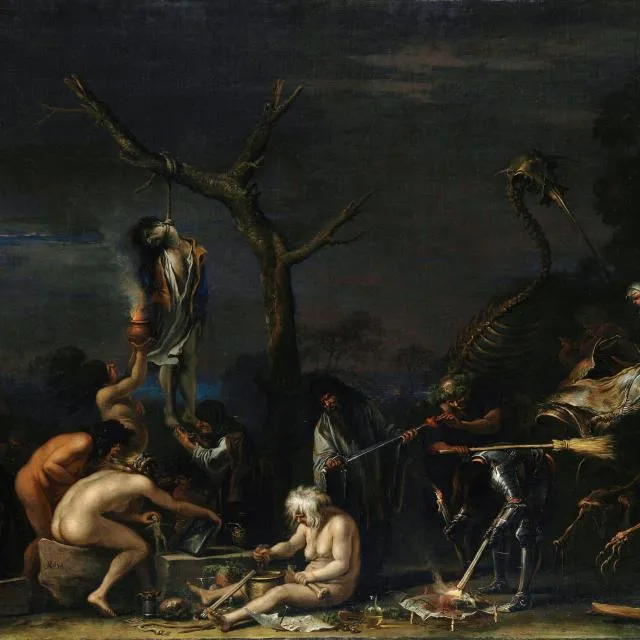
A scowling man wearing a scholar’s cap and brown gown appears before us. His drapery, wrapped tightly around him, has the smooth, solid look of a sculpted Roman bust. Half of his face is in shadow and the cold lighting emphasises his long, narrow nose, unkempt hair, unshaven face and furrowed brow. The low viewpoint makes it feel as if the man is looming over us. This, along with his intense gaze and the setting of his dark form against a stormy sky, creates a powerful impression and a slightly threatening mood.The man thrusts a tablet bearing a Latin inscription towards us – translated, it reads: ‘Keep silent, unless your speech is better than silence.’ The phrase is taken from Stobaeus’s Anthologia, a fifth-century collection of extracts from Greek authors. Rosa later created his own compilation of witty sayings in Il Teatro della Politica, which included several on the virtues of silence, a concept associated with many philosophers of antiquity.There has been much debate over the identity of the sitter. Due to an eighteenth- or nineteenth-century inscription on the back of the painting, the picture was thought to be a self portrait when it entered the National Gallery’s collection, but recent scholarship has shown that it was originally painted as a personification of philosophy. It has a pendant, Poetry (now in the Wadsworth Atheneum, Hartford, Connecticut) – the woman depicted in that picture was probably based on a portrait of Rosa’s long-term companion, Lucrezia. Philosophy reflects a wider interest in philosophical debates and the thinkers of antiquity that existed in Italy during the seventeenth century. The composition and sombre colouring recall the half-length depictions of philosophers painted in Naples by Ribera during the 1630s.Rosa painted Philosophy during the early 1640s, while he was in Florence, for Filippo Niccolini, tutor and later chamberlain of Rosa’s patron Giovan Carlo de' Medici. Niccolini shared Rosa’s passion for theatre and belonged to the circle of learned men the artist had befriended during his stay. Rosa took inspiration from the philosophers, scientists and actors he met in Florence and Rome, many of whom shared his fascination with dark and disturbing subjects, such as the one explored in Witches at their Incantations. He wished to be recognised as a painter of philosophical subjects rather than a specialist in types of art considered inferior at the time, like landscapes and genre scenes. To his frustration, this was a reputation he never quite achieved, and he was most original as a landscape artist.
68 collected·59 zoomed·1 comments
About this artwork
Philosophy (about 1645) by Salvator Rosa, oil on canvas, from the National Gallery, London collection.
More by Salvator Rosa
Comments (0)
No comments yet. Be the first to share your thoughts.