

Portrait of a Lady

1683 · Oil on canvas
Dimensions 78.5 x 62 cm
Collection: National Gallery, London
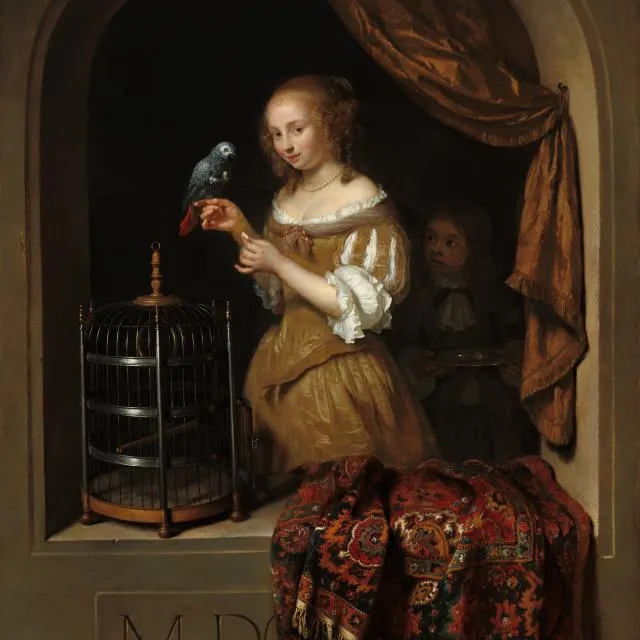
A young woman sits on a stone bench in a garden. She leans her elbow on a plinth as if trying to be at ease but her bodice, stiffened with whalebone, forbids her to relax. She sits upright, her eyes alert as if expecting someone. Who this might be remains a mystery, since we don‘t know her identity or her family circumstances.Soft auburn curls surround her face and hang in ringlets that fall on to her bosom; her breasts are pushed up and almost exposed by the corset top. Her neck is encircled with pearls that show off her almost startlingly pale complexion, and her pale, languid arms appear from a froth of fine white linen. The slender fingers show the influence of the Flemish portrait painter Anthony van Dyck – look at his Lady Elizabeth Thimbelby and Dorothy, Viscountess Andover for example – and demonstrate the gentility of the sitter: these hands don’t take on any menial tasks.Over one shoulder a length of rich blue satin contrasts deliciously with the deep russet colour of the gown and a tiny pointed slipper peeps out from her heavy skirts. The light catches the gleaming fabric, drawing attention to the little bunch of orange blossom on her knee. And here we can begin to find at least a hint of her history.Orange blossom may suggest that she was a supporter of the House of Orange (in effect the rulers of the Netherlands) but it has a long tradition as a symbol of purity and chastity, and of marriage and fertility. In the seventeenth century orange blossom was usually shown in paintings as a small bouquet, as in this picture. Later on in the nineteenth century it often appeared as a bridal headdress.Behind the young woman is a stone cherub holding an urn over his head, while two more cherubs, tangled in an embrace, are carved onto the wall. They could also be a symbol of the delights of marriage, though arranged marriages were common among the aristocratic families of Europe at the time, often diplomatic contracts that didn't always guarantee happiness.Oddly, although she’s sitting in a garden, a heavy curtain billows down next to her. It’s a theatrical moment that adds a little more atmosphere to Caspar Netscher’s portrait of the elegant young woman – whoever she may be.
52 collected·42 zoomed·0 comments
About this artwork
Portrait of a Lady (1683) by Caspar Netscher, oil on canvas, from the National Gallery, London collection.
About Caspar Netscher
Caspar (or Gaspar) Netscher (1639 – January 15, 1684) was a Dutch portrait and genre painter. He was a master in depicting oriental rugs, silk and brocade and introduced an international style to the Northern Netherlands.
More by Caspar Netscher
Comments (0)
No comments yet. Be the first to share your thoughts.