

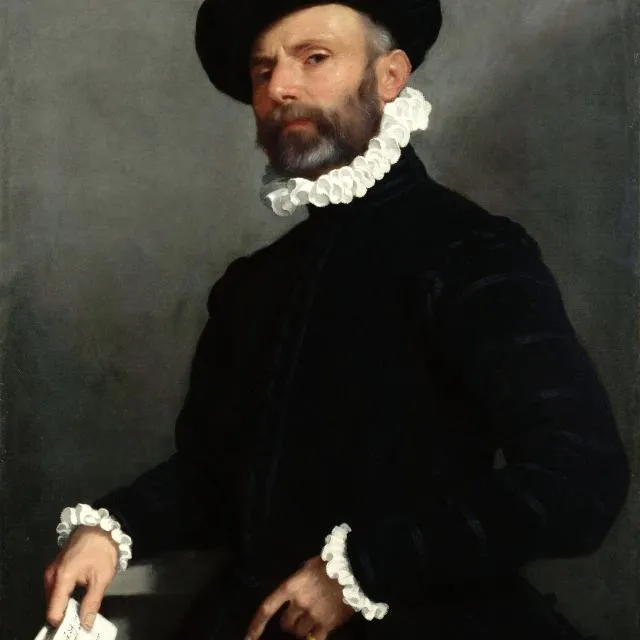
Portrait of a Left-Handed Gentleman with Two Quartos and a Letter ('Il Gentile Cavaliere')

about 1564-5 · Oil on canvas
Dimensions 100.4 x 81.2 cm
Collection: National Gallery, London
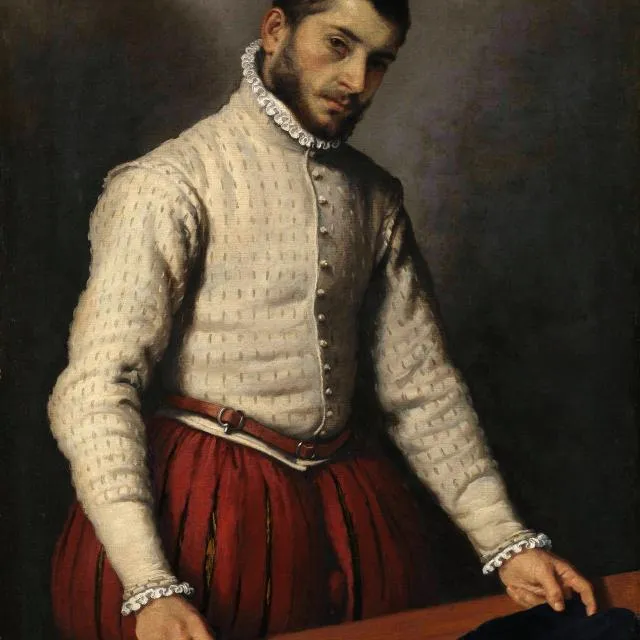
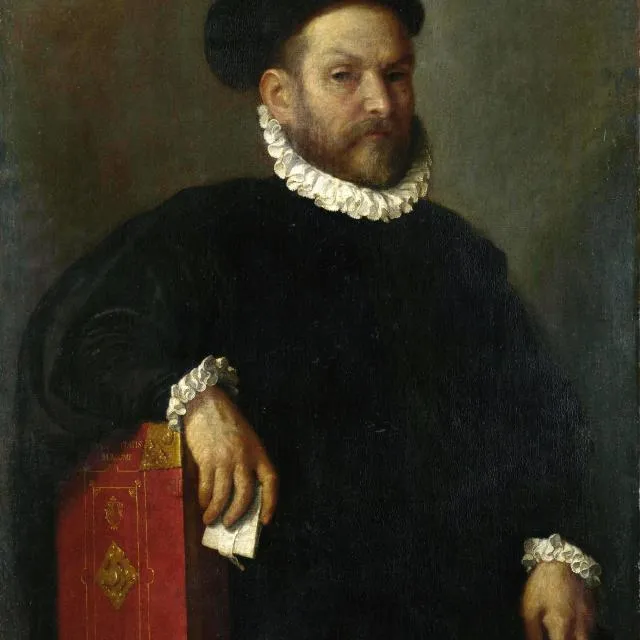
The traditional Italian title of this portrait, ‘Il Gentile Cavaliere’, means the ‘well-born gentleman’. The two quarto-sized leather-bound books on which he leans his hand, and his prominent sword – a symbol of gentility – suggest that this nobleman is a man of learning as well as action.As in many of Moroni’s portraits, the man holds a letter that records his identity. It is addressed ‘al...Sig’ (To Lord), but the name is now illegible. Below that is written ‘Berg’, for Bergamo. The black costume decorated with gold braid is typical of the French court and would have been a contrast to the Spanish fashion dominant in Bergamo at the time. The angle at which the cap is placed on the man’s head, as well as its jewelled band decorated with pearls, is similar to those in portraits by the French painter Clouet. A surprisingly large number of old versions of this portrait survive, which suggests that the sitter was someone important.Since the sword is worn on the man’s right side, he must be left-handed. It is very rare to find an explicit reference to left-handedness in a portrait of this date. Although there are references to left-handed swordsmen in literature of the period, left-handedness generally had negative associations. The sword has a hilt of chiselled steel with a pommel decorated with a pattern of linked circles. The dagger, worn on the man’s left, has a pommel decorated with domed projections.Moroni’s earlier portraits of the 1550s, such as A Knight with his Jousting Helmet are meticulously painted, with crisp outlines, and often feature ruined architectural settings. In Portrait of a Left-Handed Gentleman, Moroni adopts a softer, more atmospheric approach which enhances the startling naturalism of the face, and he pays new attention to the expressive potential of the sitter’s hands.The muted grey background is very freely painted – large unblended brushstrokes of dark paint are swept over and into lighter still-wet paint. The background must have been painted late as it passes over the edge of the sitter’s right arm. The plain background, looser technique and rapid brushwork are typical of Moroni’s portraiture of the mid-1560s. This dating is also confirmed by the style of the ruff and that of the braided doublet with its low waist.Moroni is different from Titian and his other contemporaries in that he needed his portrait sitters in front of him; other portraitists were better able to imagine or reinvent their sitters from drawings or memory. The striking naturalism and psychological depth of Moroni’s portraits is a direct result of painting from life. We don‘t just look at his sitters, we feel we are engaging with them on a personal level. Moroni’s skill at expressing his sitters’ inner lives continued to develop during his final years in works such as The Tailor and Portrait of a Man holding a Letter.
55 collected·41 zoomed·0 comments
About this artwork
Portrait of a Left-Handed Gentleman with Two Quartos and a Letter ('Il Gentile Cavaliere') (about 1564-5) by Giovanni Battista Moroni, oil on canvas, from the National Gallery, London collection.
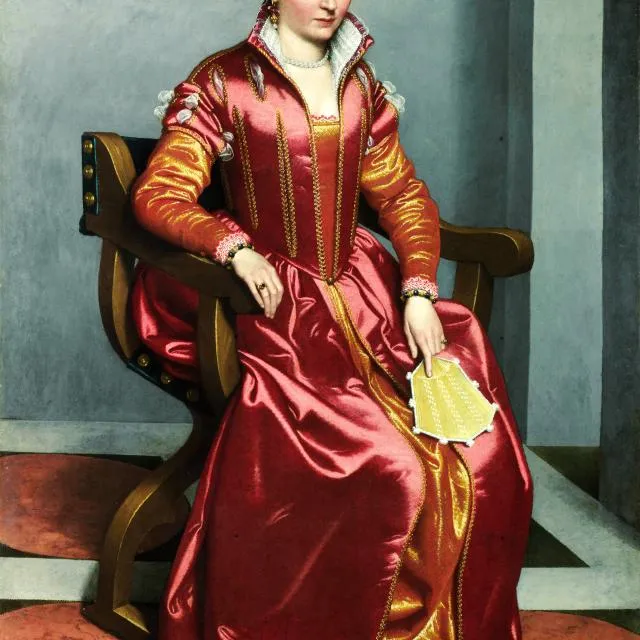
More by Giovanni Battista Moroni
Comments (0)
No comments yet. Be the first to share your thoughts.