

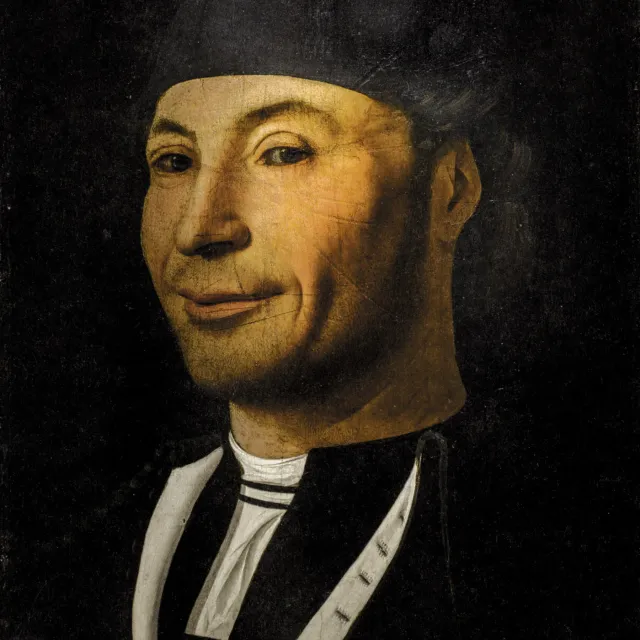
Portrait of a Man

about 1475-6 · Oil on poplar
Dimensions 35.6 x 25.4 cm
Collection: National Gallery, London
This painting was once thought to be a self portrait, a mistake that probably arose from the misreading of an inscription on its original frame. But the man’s gaze is so serious that he might be taken for an artist examining his reflection.Antonello’s portraiture achieved a level of intensity that had not been seen before this time in Italy. Only 12 of his portraits survive and all have the same format: the sitters – all men – are depicted bust length (head and shoulders only, so they look like a sculpted portrait bust), placed against dark backgrounds and lit by a strong, cool light. All the images are tightly cropped and the sitters stare directly at the viewer. With all possible distraction removed, only the sitter’s face and expression are available for interpretation, inviting us to focus on their character rather than outward shows of status or wealth.Antonello adopted this format from paintings made in Flanders – a key example of the type is van Eyck’s self portrait, made in 1433. Antonello was a native of Sicily, and it has been suggested that his knowledge of the painting of the Low Countries and his skill in using oil paint were developed through training he received there, and that he introduced the medium to Venice when he travelled there in 1475. This is highly unlikely: oil paint was being used in northern Italy earlier in the fifteenth century.Antonello seems to have refined his technique while in Venice, as he adopted the oil paint medium wholeheartedly along with his Venetian contemporaries. His pictures are distinctive for the way they imitate the precision and refinement of works by Netherlandish artists that were hugely popular in Venice. Oil paint enabled him to portray a range of textures – its sheen conveys the glossiness of the man’s large eyes, for example – and he also scraped through the paint to achieve the effect of having painted individual hairs on the man’s head.Lighter paint has been used to suggest light catching the tip of the man’s nose and his sharp cheekbones; the underside of his chin and the left side of his jaw are cast in shadow. In between these extremes of light and shade are numerous mid-tones that make these transitions subtle and naturalistic. There are no harsh lines between the palest part of his skin, under his right eye, and the area just above it, beneath his eyebrow. By varying the tones in this subtle way, Antonello achieves a three-dimensional effect where the head appears to emerge from the darkness of the background. This technique was adopted by many other Venetian portraitists such as Alvise Vivarini.
59 collected·33 zoomed·0 comments·1 boards
This artwork is in 1 board
About this artwork
Portrait of a Man (about 1475-6) by Antonello da Messina, oil on poplar, from the National Gallery, London collection.
More by Antonello da Messina
Comments (0)
No comments yet. Be the first to share your thoughts.