

Portrait of a Man ('Léal Souvenir')

1432 · Oil on oak
Dimensions 33.3 x 18.9 cm
Collection: National Gallery, London
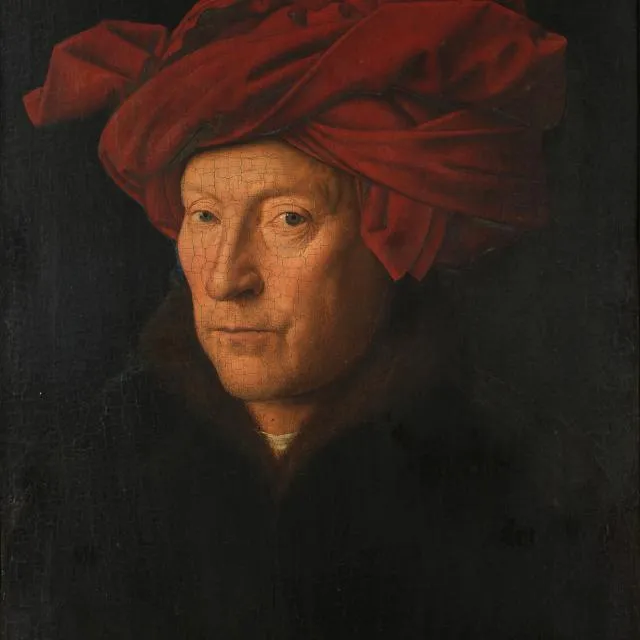
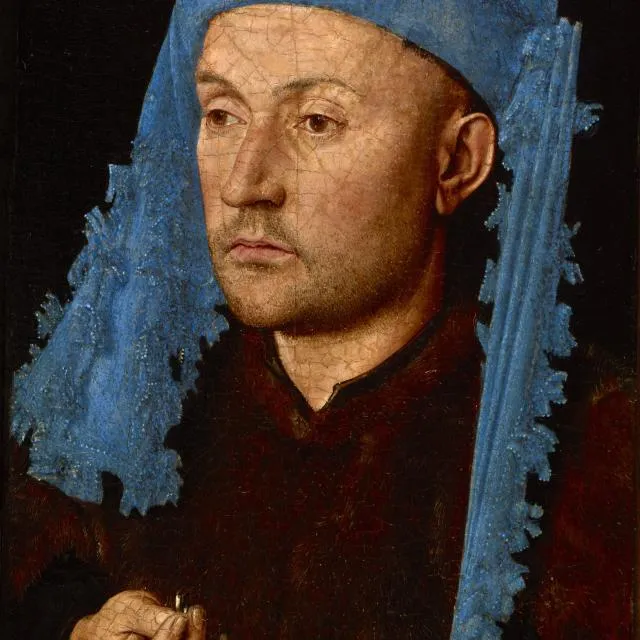
This small portrait is puzzling in many ways. We don‘t know who this man was or why he is holding a scroll, which is – rather strangely – inscribed on the outside. The painting’s tall, narrow shape is unusual and there are mysterious inscriptions on the large, cracked stone parapet which runs along the front.At the bottom is van Eyck’s signature in abbreviated Latin: Actu[m] an[n]o d[omi]ni 1432 10 die octobris a ioh[anne] de Eyck (’done on 10 October 1432 by Jan van Eyck‘). Van Eyck often dated his paintings to a single day, although they would have taken much longer to complete; perhaps this was they day on which it was finished. Above this are large capitals, apparently carved into the stone, reading ’LEAL SOVVENIR‘ (’Loyal Remembrance‘), the words divided by a deep crack in the stone. This is the only French inscription on a surviving picture by van Eyck. It might mean that the picture is a good likeness, or that it was meant to be a keepsake. It is possible that it was painted after the sitter’s death, in which case the crumbling parapet might be an allusion to man’s mortality.At the top of the parapet, carefully centred, is a small white inscription in Greek letters. There are two words, written in Greek, the last letter disappearing into a chip in the stone. Van Eyck often used the Greek alphabet to spell out words in Latin or Dutch. Here it is Latin: TUM OTHEOS (’then God‘). What this means is unclear.Even the phrasing of van Eyck’s signature is unusual, and is reminiscent of the wording of a legal document. The scroll in the sitter’s hand looks like a legal deed, although it is rolled inside out so the writing is on the outside. Could he have been a lawyer? He is dressed as a prosperous member of the middle class, in a dark green chaperon, fashionable fifteenth-century male headgear which van Eyck showed in several portraits (for example Portrait of a Man (Self Portrait?)). Its short hood falls over his left shoulder, and the long scarf-like cornette hangs down by his right. His red houpelande – a long-sleeved robe worn by both men and women – is trimmed with brown fur and fastened at the neck with two small buttons.Van Eyck often put his sitters’ names on the frames of their portraits, but this has been lost and the panel has been trimmed down almost to the edge of the paint. The back was marbled but this is now very damaged. Paintings were not always hung on walls in the fifteenth century, as is usual now, and the backs were sometimes decorated too as they could be seen.
52 collected·34 zoomed·0 comments
About this artwork
Portrait of a Man ('Léal Souvenir') (1432) by Jan van Eyck, oil on oak, from the National Gallery, London collection.
About Jan van Eyck
Jan van Eyck (c.before 1390 – 9 July 1441) was a painter from the County of Loon (present day Belgium) active in Bruges. He is one of the early innovators of what became known as Early Netherlandish painting, and one of the most significant representatives of Early Northern Renaissance art.
More by Jan van Eyck
Comments (0)
No comments yet. Be the first to share your thoughts.