

Portrait of Dr. Samuel D. Gross (The Gross Clinic)

1875 · Oil on canvas
Dimensions 240 × 200 cm
Collection: Art Whisperer
Many art historians consider The Gross Clinic to be one of the best American paintings ever made. Dr. Samuel D. Gross, a seventy-year-old professor dressed in a black frock coat, lectures a group of Jefferson Medical College students. Included among the group is a self-portrait of Eakins, who is seen at the left-hand side of the painting, next to the tunnel railing, with a white cuffed sleeve sketching or writing. Seen over Dr. Gross's right shoulder is the clinic clerk, Dr. Franklin West, taking notes on the operation. Admired for its uncompromising realism, The Gross Clinic has an important place documenting the history of medicine—both because it honors the emergence of surgery as a healing profession (previously, surgery was associated primarily with amputation, which often resulted in infection, and sometimes death), and because it shows what the surgical theater looked like in the nineteenth century. The painting is based on a surgery witnessed by Eakins, in which Gross treated a young man for osteomyelitis of the femur. Gross is pictured here performing a conservative operation, as opposed to the amputation normally carried out. Here, surgeons crowd around the anesthetized patient in their frock coats—this is just prior to the adoption of a hygienic surgical environment (see asepsis). The Gross Clinic is thus often contrasted with Eakins's later painting The Agnew Clinic (1889), which depicts a cleaner, brighter, surgical theater, with the participants in "white coats". In comparing the two, the advancement in understanding of the prevention of infection is seen. Another noteworthy difference in the later painting is the presence of a professional nurse, Mary Clymer, in the operating theater. It is assumed that the patient depicted in The Gross Clinic was a teenage boy, although the exposed body is not entirely discernible as male or female; the painting is shocking for both the odd presentation of this figure and the matter-of-fact goriness of the procedure. Adding to the drama is the lone woman in the painting seen in the middle ground, possibly the patient's mother, cringing in distress. Her dramatic figure functions as a strong contrast to the calm, professional demeanor of the men who surround the patient. This bloody and very blunt depiction of surgery was shocking at the time it was first exhibited. The painting was submitted for the 1876 Centennial Exhibition in Philadelphia, but was rejected by the Committee of Selection. When it was eventually displayed in Ward One of the U.S. Army Post Hospital, a critic for the New York Tribune wrote that it was: ...one of the most powerful, horrible, yet fascinating pictures that has been painted anywhere in this century...but the more one praises it, the more one must condemn its admission to a gallery where men and women of weak nerves must be compelled to look at it, for not to look at it is impossible. Another critic, writing in 1885, said: It is characterized by so many excellent artistic qualities, that one regrets that the work as a whole fails to satisfy. Admirable draughtsman as this painter is, one is surprised that in the arrangement of the figures the perspective should have been so ineffective that the mother is altogether too small for the rest of the group, and the figure of the patient so indistinct that it is difficult to tell exactly the part of the body upon which the surgeon is performing the operation. The monochromatic tone of the composition is, perhaps, intentional, in order to concentrate the effect on the bloody thigh and the crimson finger of the operating professor. But as it is, the attention is at once and so entirely directed on that reeking hand as to convey the impression that such concentration was the sole purpose of the painting. In similar paintings by Ribera, Regnault, and other artists of the horrible, as vivid a result is obtained without sacrificing the light and color in the other parts of the picture; and the effect, while no less intense, is, therefore, less startling and loud. These assessments were not universal. The critic for Philadelphia's The Evening Telegraph, who may have been aware of the personal politics involved in the advisory group of artists who rejected it, wrote: There is nothing so fine in the American section of the Art Department of the Exhibition, and it is a great pity that the squeamishness of the Selecting Committee compelled the artist to find a place for it in the United States Hospital building. It is rumored that the blood on Dr. Gross' fingers made some of the members of the committee sick, but, judging from the quality of the work exhibited by them we fear that it was not the blood alone that made them sick. Artists have before now been known to sicken at the sight of pictures by younger men which they in their souls were compelled to acknowledge were beyond their emulation. Controversy about the painting has centered on its violence, and on the melodramatic presence of the woman. Modern scholars have suggested that the painting may be read in terms of castration anxiety and fantasies of mastery over the body (e.g. Michael Fried), and that it documents Eakins's ambivalence about representing sex difference (e.g. Jennifer Doyle). The painting has also been understood to be drawing an analogy between painting and surgery and as identifying the work of the artist with the emergence of surgery as a respected profession.
214 collected·508 zoomed·1 comments
About this artwork
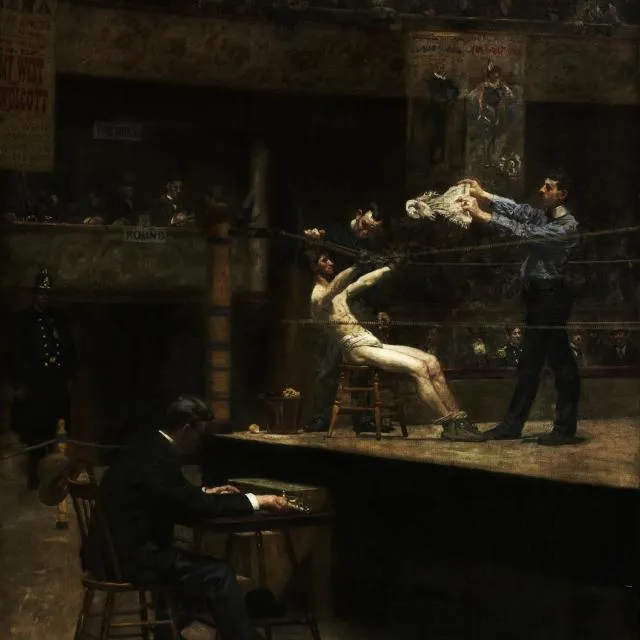
Portrait of Dr. Samuel D. Gross (The Gross Clinic) (1875) by Thomas Eakins, oil on canvas, from the Art Whisperer collection.
About Thomas Eakins
Thomas Cowperthwait Eakins (July 25, 1844 – June 25, 1916) was an American realist painter, photographer,[1] sculptor, and fine arts educator. He is widely acknowledged to be one of the most important artists in American art history.
More by Thomas Eakins

Comments (0)
No comments yet. Be the first to share your thoughts.