

Portrait of the Abbé Scaglia

1634 · Oil on canvas
Dimensions 200.6 x 123.2 cm
Collection: National Gallery, London
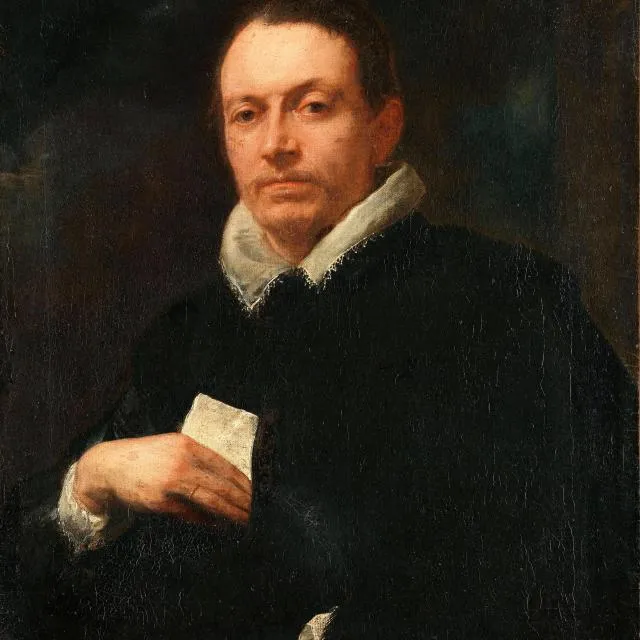
This is Cesare Alessandro Scaglia di Verrua (1592–1641), the second son of a count. He initially trained for the church and although he never took holy orders he nevertheless received income from various abbeys. The Abbé’s real career was as a diplomat; he served as ambassador for the House of Savoy in Rome, Paris and Madrid, and went on to become a diplomat and possibly a spy in the courts of Europe. As the Duke of Savoy’s ambassador to the Vatican, he tried and failed to be made a cardinal. In 1624 he moved to Paris; by 1626 he was in London; in 1627 he was in the Low Countries; and in 1628 in Spain. For nearly a decade, between 1629 and 1637, he moved around the courts of Europe with Brussels and then Antwerp as his base. His diplomatic career served as cover for his secondary role as a gatherer of intelligence for the Duke of Savoy and Philip IV of Spain, and he was known in official documents as ‘Agent 2X’.Scaglia, an ambitious, intelligent and subtle man, was also an art collector and patron of long standing who knew some of the greatest painters of the age; not just Van Dyck but Rubens, Jordaens, and Velázquez, with whom he travelled from Madrid to Genoa in 1629. He was also friendly with the English architect and cultural adviser to Charles I, Inigo Jones, and undertook art-buying expeditions for the king.Van Dyck was another well-travelled figure, and he and Scaglia might have met as early as 1623 in Turin. The Abbé became one of his most important patrons and their relationship continued to the late 1630s. Scaglia’s will shows that he owned at least seven paintings, and possibly as many as ten, by Van Dyck – a mixture of portraits, religious works and a mythological scene.Van Dyck’s portrait shows Abbé Scaglia as a somewhat severe figure leaning against a column, his ecclesiastical robes mimicking the togas of Roman statues. Preparatory drawings indicate that Van Dyck initially intended to show Scaglia seated but changed his mind (the chair remains in the background). His elongated pose gives him real presence and the painter imparts a sense of life and movement through the slight twist to the head, the lean into the column and the hands held at different levels. Van Dyck enlivens the severity of the Abbé’s black garb through the elegance of his hands and the way he lifts the hem of his robe just enough to show his shoes poking out. The dark ‘halo’ around Scaglia’s head is the dark background to Van Dyck’s initial head study, which is now emerging through the paint. Meanwhile, the eye contact Scaglia makes with the viewer confirms Rubens’s assessment of him as ‘a man of the keenest intellect’. Van Dyck agrees: here is a man to be reckoned with.
69 collected·123 zoomed·1 comments·1 boards
This artwork is in 1 board
About this artwork
Portrait of the Abbé Scaglia (1634) by Sir Anthony van Dyck, oil on canvas, from the National Gallery, London collection.
About Sir Anthony van Dyck
Sir Anthony van Dyck, 22 March 1599 – 9 December 1641) was a Flemish Baroque artist who became the leading court painter in England after success in the Southern Netherlands and Italy.
More by Sir Anthony van Dyck
Comments (0)
No comments yet. Be the first to share your thoughts.