

Portrait of Vincenzo Morosini

about 1575-80 · Oil on canvas
Dimensions 85.3 x 52.2 cm
Collection: National Gallery, London
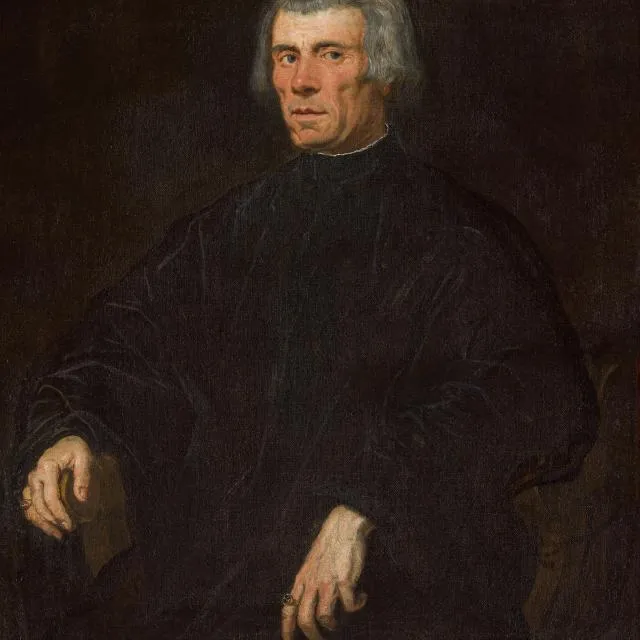
This man with his shrewd and slightly suspicious expression has been identified as Vincenzo Morosini (1511–1588), a powerful Venetian official. He appears in two other paintings in Venice by Tintoretto: a large ceiling canvas in the Doge’s Palace, inscribed with his name and dated 1580; and in the altarpiece for his family chapel in the church of S. Giorgio Maggiore. The National Gallery’s portrait was probably made as a studio model for both paintings. Vincenzo Morosini may have had a special admiration for Tintoretto. In 1648, the art biographer Carlo Ridolfi recorded that Morosini owned a Virgin and Child, a Vulcan, and a picture of Saint Lawrence, all by Tintoretto.Vincenzo Morosini belonged to one of the oldest, proudest and richest families of Venice. In 1565 the Senate elected him as one of the chief counsellors of the mainland territories of Venice, a very senior post with military and financial responsibilities. In 1571 during the War of Cyprus he was put in charge of the defence of the Venetian Lagoon against the threat of Turkish invasion.In 1572, he was sent to represent the Venetian state at the Coronation of Pope Gregory XIII. It was probably then that he was made Cavaliere of the Stola d‘Oro (Knight of the Golden Stole). This was a special Venetian honour bestowed by the Senate and represented by the golden embroidered band that Morosini wears over his shoulder in this portrait.Vincenzo was elected to oversee the reconstruction and redecoration of the Doge’s Palace after the fires of 1574 and 1577 and, in 1578, he became one of the nine procurators of Saint Mark’s, which was the most coveted office after that of doge. He was buried in the church of S. Giorgio Maggiore in 1588, the monastery of which had been founded by his ancestor, the Blessed Giovanni Morosini, in 982.Tintoretto depicted with sympathy the wrinkled flesh, veined foreheads, thin beards and watery eyes of the old men who ruled Venice. In this portrait study, among his most sensitive, Morosini’s face is carefully composed of many paint layers, while his clothes are rapidly dashed-in. Rough streaks of lead-tin yellow imitate the gold threads on the stole, which is painted on top of the crimson robe. The white fur lining of Morosini’s gown has a pink tinge in places where it was applied over crimson paint that was still wet. As the pale blue-green paint of the hills has become more transparent, the dark underpaint, or ground, beneath has appeared. When analysed under a microscope, the ground appears to have been made from a mixture of leftover paint scrapings from the palette for another painting. If the portrait was painted as a studio model for other paintings, its shape and lesser details wouldn’t have mattered so much.The present shape of this portrait is unusually narrow, and it may have been trimmed along the right-hand side – Morosini’s arm and the landscape have been awkwardly cut. The sky and landscape originally extended further to the left but were then partly concealed by the dark wall Tintoretto painted over them.
61 collected·63 zoomed·0 comments
About this artwork
Portrait of Vincenzo Morosini (about 1575-80) by Jacopo Tintoretto, oil on canvas, from the National Gallery, London collection.
More by Jacopo Tintoretto
Comments (0)
No comments yet. Be the first to share your thoughts.