

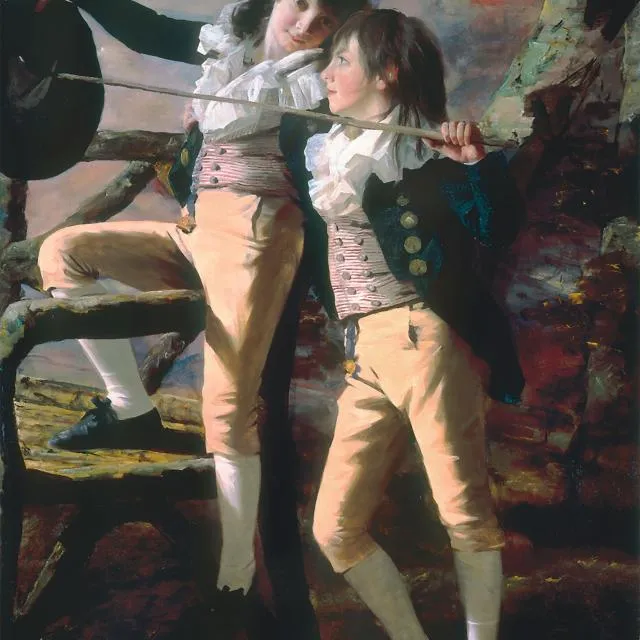
Robert Ferguson of Raith 1770-1840 and Lieutenant-General Sir Ronald Ferguson 1773-1841 ('The Archers')
about 1789-90 · Oil on canvas
Dimensions 110.5 x 123.6 cm
Collection: National Gallery, London
‘The Archers’ is one of a small number of outstanding portraits from the early part of Raeburn’s career, in which he used an exceptionally accomplished and subtle combination of arresting compositions and dramatic lighting to create a sense of intimacy between the viewer and the sitters.The portrait was probably painted in about 1789 or 1790, when the subjects were in their late teens. Robert and Ronald Ferguson became members of the Royal Company of Archers in 1792 and 1801 respectively, and the contemporary revival of archery as a fashionable sport appears to have inspired the composition. In 1770 Reynolds, the dominant English portraitist, had exhibited his portrait of two archer friends, Thomas Townshend and Colonel Acland, at the Royal Academy in London (now at Tate Britain, London). However, it is unlikely that Raeburn ever saw that painting and Reynolds’s over-charged, full-length action portrait is quite different to Raeburn’s rational and still approach.The two Ferguson brothers are shown in a striking and complex geometrical arrangement that plays on tonal contrasts. The left-hand boy’s powdered hair and dominant position imply that he is Robert, the elder brother (although family tradition identifies the brothers the other way round). In a wonderfully outlined profile, he is lit from the left, while Ronald behind him is shown entirely in shadow, gazing out at the viewer while framed in the tautened bow held by his brother. The horizontal arrow precisely divides the canvas in two. The way the figures are arranged resembles a classical sculptural frieze – appropriate to Scotland of the Enlightenment, when classicism and a renewed interest in antiquity influenced the thought and aesthetics of the country. The stillness, darkness and broad, confident application of paint combine to create a sense of hushed atmosphere, which is at once formal and verging on the romantic. The bold but sensitive manner of painting recalls some of the double portraits of courtiers by Van Dyck in the previous century, such as Lord John Stuart and his brother Lord Bernard Stuart.Robert Ferguson became a Whig Member of Parliament and succeeded his father to the estate of Raith in 1810. He was a dedicated collector of books and pictures. Ronald joined the Army and had a distinguished and varied career, becoming general in 1830 and also sitting in parliament. The Scottish lawyer and literary figure Lord Cockburn (1779–1854) said of them: ‘Nothing could be more beautiful than the mutual affection of these handsome, gentlemanlike, and popular brothers.’It was works such as The Archers that established Raeburn’s long and successful career as a portraitist. He was the first Scottish artist to be able to pursue such a career from Edinburgh rather than London. The Ferguson family also commissioned other portraits from Raeburn, including a full-length portrait of Robert out shooting with his dog (private collection) of about the same period as The Archers.The Archers remained in the Ferguson family collection until it was acquired in 2000 by the National Gallery under the Acceptance in Lieu scheme.
53 collected·40 zoomed·0 comments
About this artwork
Robert Ferguson of Raith 1770-1840 and Lieutenant-General Sir Ronald Ferguson 1773-1841 ('The Archers') (about 1789-90) by Sir Henry Raeburn, oil on canvas, from the National Gallery, London collection.
About Sir Henry Raeburn
Sir Henry Raeburn (4 March 1756 – 8 July 1823) was a British portrait painter and Scotland's first significant portrait painter since the Union to remain based in Scotland. He served as Portrait Painter to King George IV in Scotland.
More by Sir Henry Raeburn
Comments (0)
No comments yet. Be the first to share your thoughts.