

Saint Catherine of Alexandria

1476 · Tempera on poplar
Dimensions 137.5 x 40 cm
Collection: National Gallery, London
This golden-haired princess is Saint Catherine of Alexandria, identifiable by her attributes of a spiked wheel and martyr’s palm. She comes from the great polyptych (multi-panelled altarpiece) which Crivelli painted for the church of San Domenico in Ascoli Piceno in the Italian Marche.The graceful use of line and a fascination with decorative detail are typical of Crivelli, as is his interest in spatial games. Although the background is gold – indicating that she is heaven – Catherine stands on a marble shelf which seems to recede sharply. In a kind of Renaissance virtual reality, the toe of her shoe peeps out over the edge of the marble parapet and casts a shadow on it, as if she is about to step out of the panel into our space. To show off his skill with foreshortening, Crivelli depicts her wheel sideways on, at a dramatically acute angle. This was a relatively novel way of showing objects in the late fifteenth century – compare it to the flat wheel held by Saint Catherine in Giovanni da Milano’s Christ and the Virgin Enthroned with Six Saints.Catherine was a scholarly Christian princess who lived in third-century Alexandria under Roman rule. When she asked the Roman Emperor to stop persecuting Christians, he sent his best philosophers to debate with her and to persuade her to revert to paganism. They failed and many converted to Christianity on the strength of Catherine’s arguments. The Emperor then asked her to marry him. When she refused, he had her tortured on a wheel and finally beheaded.She was beloved by the Dominican Order, who commissioned this altarpiece, as a martyr who defended the Christian faith against pagans and heretics through intellectual argument. The Dominicans were one of the two great mendicant or preaching orders founded in the Middle Ages to provide educated preachers in towns and cities (the others being the Franciscans). One of their main concerns was to combat heresy, both through scholarly debate and through the Inquisition, which they organised.Although she lived in the third century, Catherine is here dressed in fifteenth-century fashion. She wears an overdress of red and gold figured silk, such as was produced in medieval Italy. This is laced under her arms and has a broad gold collar and elaborate clasps of gilded pastiglia. The fastenings down the front have been left open to reveal her linen shift, and her sleeves slashed to allow it to escape in elegant puffs – sleeves at this time were detachable, and so tight that it was impossible to move unless openings were left. The shift itself is so fine as to be almost translucent, and is edged with a ribbon at the neck and wrists. Her sleeves are decorated with golden pelicans and phoenixes, symbols of Christ’s sacrifice on the Cross and the Resurrection. This fabric is a deliberately old-fashioned design; it is very similar to that worn by one of the kings in The Wilton Diptych, made around 80 years earlier. This would have been immediately clear to fifteenth-century Ascolians as the Marche was a centre of the textile industry. Crivelli is making the point that although she is dressed in contemporary clothes, Catherine lived in the ancient past.Her forehead has been shaved to give it greater height, as was the fashion at the time, and her long blonde hair wound in fantastic curls around her coronet. The coronet and the neckline of her dress are decorated with small balls, one of which is missing. These would have been silvered to imitate pearls. Her dress and hairstyle are very similar to that of Saint Lucy, whom Crivelli painted for a smaller polyptych for the same church.
85 collected·97 zoomed·0 comments
About this artwork
Saint Catherine of Alexandria (1476) by Carlo Crivelli, tempera on poplar, from the National Gallery, London collection.
About Carlo Crivelli
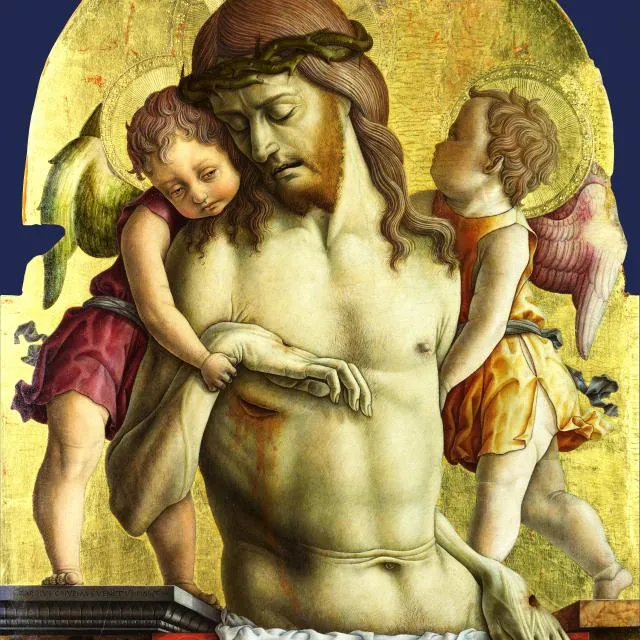
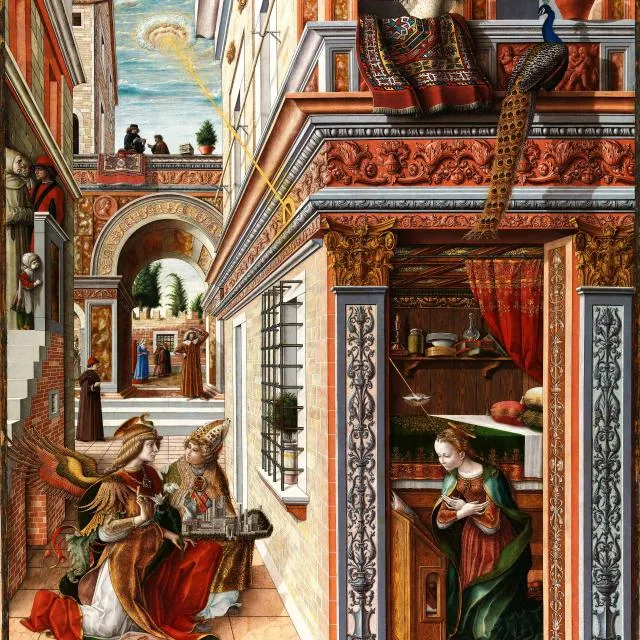
Carlo Crivelli (Venice c. 1430 – Ascoli Piceno 1495) was an Italian Renaissance painter of conservative Late Gothic decorative sensibility, who spent his early years in the Veneto, where he absorbed influences from the Vivarini, Squarcione and Mantegna.
More by Carlo Crivelli
Comments (0)
No comments yet. Be the first to share your thoughts.