

Saint Dominic

1476 · Tempera on poplar
Dimensions 137.5 x 40 cm
Collection: National Gallery, London
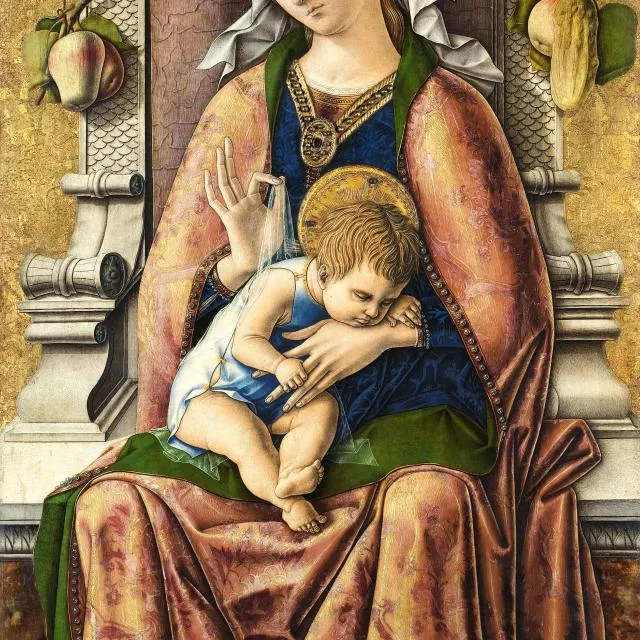
This saintly friar comes from a large paintings:group82|polyptych (a many-panelled altarpiece) that [[people:crivelli_carlo|Crivelli painted in 1476]] for the high altar of church of San Domenico at Ascoli Piceno in the Italian Marche. This is Saint Dominic himself, holding a white lily to symbolise his chastity and the book of his Rule – the code of practice for the religious order he founded.The Dominicans, often known as the ‘Blackfriars’ in England, were one of the two great mendicant or preaching orders founded in the Middle Ages to provide educated preachers in towns and cities (the other being the Franciscans). Mendicant comes from mendicare, or ‘to beg’ in Latin. Men who joined the mendicant orders took vows of poverty and travelled from place to place, preaching and living on what was given by their listeners. One of their main concerns was to combat heresy, both through scholarly debate and through the Inquisition, which they organised.The saint presses his hand to his chest, his eyes humbly lowered to gaze at the sleeping Christ Child in the centre panel (now The Virgin and Child). The severity of his black and white robes – the uniform of the Dominican Order – contrasts with the damask tooling of the burnished gold background, and with the opulence of Saint Peter’s papal regalia further to the left of the altarpiece. Showing off his skill at foreshortening, Crivelli has rotated the saint’s beautifully bound book: we see the fore-edges with their gilded clasp straight on and the pink leather covered boards only at an acute angle.Crivelli exploits the optical effects of the different gold surfaces, which must have shone and flickered in the candlelight of a medieval church, with the highly burnished gold of his halo acting as a spotlight on the saint’s face. In a detail typical of Crivelli, Dominic’s foot pokes out over the edge of the marble parapet on which he stands, and curls up slightly at the toe. The level of detail in the lilies with their golden stamens, in the sinews in the saint’s hands and feet, is characteristic of Crivelli. His skill as a painter of drapery is such that even though Dominic’s robes are black, we can see folds and creases around the neck and shoulders, and creases in the tops of his shoes.His face is a rare demonstration of Crivelli’s abilities as a portraitist. This is a highly individual face, with its long nose, deep-set eyes ringed with creases and wrinkles, and the line of an old scar running down his cheek. We know from other paintings that the figure is here in a double role: it is Saint Dominic, the founder of the Dominican Order, and a portrait of the Blessed Constanzo di Meo di Servolo (d. 1481), the leading Dominican in the Marche, the prior of San Domenico, and the commissioner of this altarpiece.
65 collected·64 zoomed·0 comments
About this artwork
Saint Dominic (1476) by Carlo Crivelli, tempera on poplar, from the National Gallery, London collection.
About Carlo Crivelli
Carlo Crivelli (Venice c. 1430 – Ascoli Piceno 1495) was an Italian Renaissance painter of conservative Late Gothic decorative sensibility, who spent his early years in the Veneto, where he absorbed influences from the Vivarini, Squarcione and Mantegna.
More by Carlo Crivelli
Comments (0)
No comments yet. Be the first to share your thoughts.