

Saint Lucy

c. 1625/1630 · oil on canvas
Dimensions overall: 104.14 × 77 cm (41 × 30 5/16 in.)
Collection: National Gallery of Art
Credit Chester Dale Collection
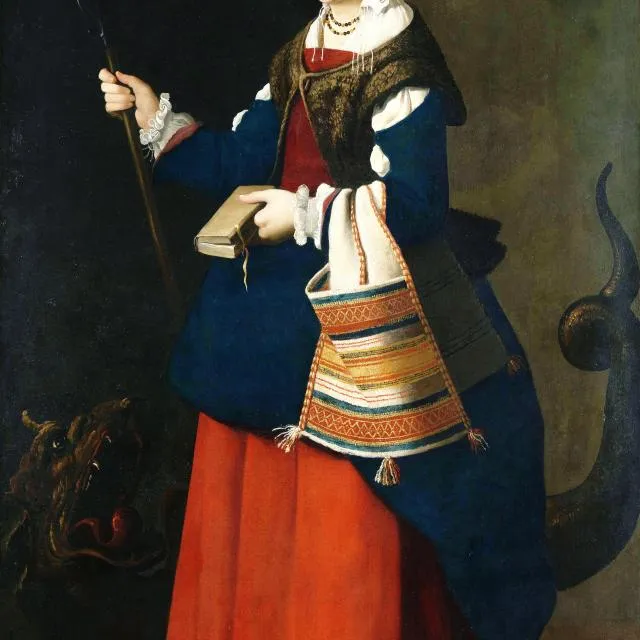
Few images of saints show women as gorgeously attired as Francisco de Zurbarán's. His Saint Lucy portrays the young martyr as a contemporary woman of Seville. Bejeweled and carefully coiffed, she presents her startling attribute, a pair of naturalistically painted eyeballs on a pewter dish.Multiple versions of the legend of Saint Lucy, the daughter of an aristocratic family in fourth-century Syracuse, arose during the Counter-Reformation. One popular interpretation, inspired by her unusual attribute, maintained that Lucy, determined to dedicate her life to Christ, had plucked out her eyes and sent them to a tenacious suitor after he insisted that their beauty allowed him no peace. Astounded by her devotion to her faith, the admirer converted to Christianity, and Lucy, the legend continues, later found her eyesight miraculously restored one day during prayer. It is possible that the young saint's connection with eyes originated in the Latin source for her name, Lux or "light," which is inextricably linked with vision.The success of Zurbarán's many images of virgin martyrs derived not only from their inherently pleasing theme -- beautiful, splendidly dressed women -- but also from the artist's gifts as a colorist and his talent for combining the spiritual and material.
203 collected·379 zoomed·2 comments
About this artwork
Saint Lucy (c. 1625/1630) by Francisco de Zurbaran, oil on canvas, from the National Gallery of Art collection.
About Francisco de Zurbaran
Francisco de Zurbarán ([fɾanˈθis.ko ðe θuɾ.βaˈɾan]; baptized November 7, 1598 – August 27, 1664) was a Spanish painter. He is known primarily for his religious paintings depicting monks, nuns, and martyrs, and for his still-lifes.
More by Francisco de Zurbaran
Comments (0)
No comments yet. Be the first to share your thoughts.