

Saint Luke painting the Virgin and Child
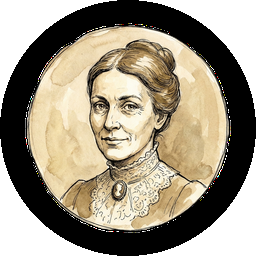
about 1520? · Oil on oak
Dimensions 114.9 x 35.4 cm
Collection: National Gallery, London
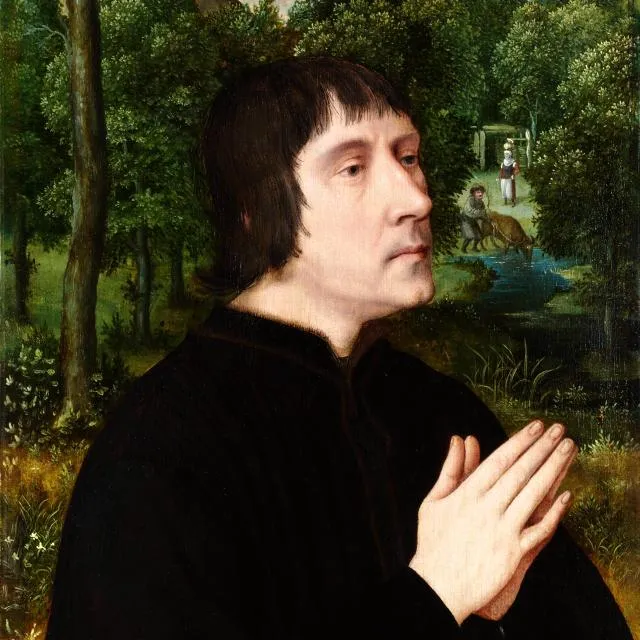
A man in a red cap, fur-lined robe and luxurious fur cape sits in a luxuriously furnished room, painting a picture. This is Saint Luke, patron saint of painters and physicians, who was thought to have painted a picture of the Virgin and Child and is called ‘Luke, the beloved physician’ in Saint Paul’s Epistle to the Colossians (4: 14). Many of the objects around him refer to these professions, and his symbol, the ox, lies at his side like a large dog.The picture is full of information on how Renaissance painters worked, although they perhaps did not always work in such comfortable surroundings. Saint Luke is seated at a three-legged easel, similar in appearance to a modern easel, and his work rests on an adjustable ledge supported by movable pegs. The painting itself, which shows the Virgin and Child, is already in its frame (various paintings in our collection show evidence of having been painted in their frames). The saint is working on the Virgin’s head and his wooded palette is set for painting flesh: in its centre he has prepared a pink by mixing white, red lake and vermillion pigments. He supports his hand with a mahlstick with a padded grey knob on the end, which rests on the frame, and has a selection of brushes – some in his hands, one resting on the ledge of the easel – with wooden handles. There is more equipment on a stool next to him: a knife; a mussel shell, possibly containing shell gold; and a glazed pot, presumably containing oil or varnish, or a thinner, or something for cleaning brushes.Behind the saint’s head is a large convex mirror, reflecting his back, the painting and the easel. The room in which he is working has an arched wooden ceiling, two windows – one is only visible in the mirror – and a tiled floor. The window on the right is glazed and there is a carved wooden bench on the back wall. Above it hang two canisters of basketwork, the protective packaging in which urine flasks – the physician’s characteristic tool – were then kept. Above these are two shelves, the lower one partially covered by a purple curtain. Several books rest on it, stacked in some disorder, fore-edges facing outwards as they would have been at this period. There are red and blue tags stuck between the pages of three of them, perhaps to mark important passages. On the top shelf are various pots and jars, doubtless pharmacist’s containers for drugs.This painting and The Virgin standing in a Niche are the back and front of the right wing of a triptych. No other parts of this altarpiece are known to survive but the centre panel probably showed a Virgin and Child. The left wing may have depicted a patron, perhaps with his saint (see Panel from a Triptych for example).
48 collected·24 zoomed·1 comments
About this artwork
Saint Luke painting the Virgin and Child (about 1520?) by Workshop of Quinten Massys, oil on oak, from the National Gallery, London collection.
More by Workshop of Quinten Massys
Comments (0)
No comments yet. Be the first to share your thoughts.