

Saint Thomas Aquinas

1476 · Tempera on poplar
Dimensions 60.5 x 39.5 cm
Collection: National Gallery, London
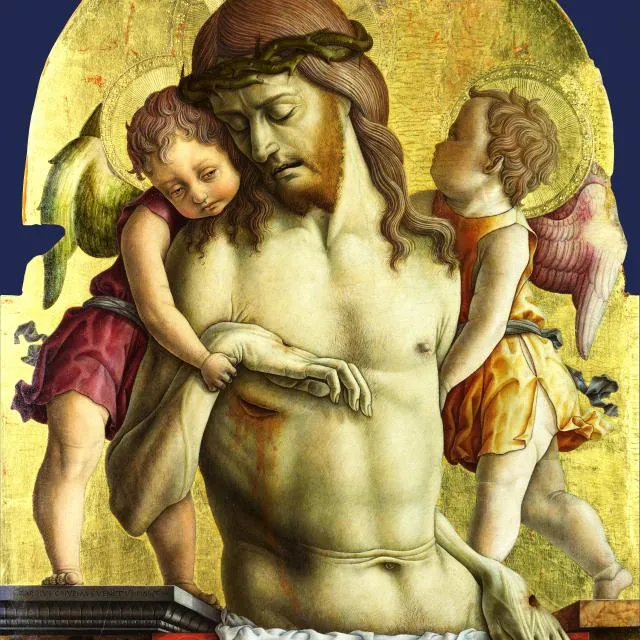
This half-length figure of a saint comes from the upper tier of a large polyptych that Crivelli painted in 1476 for the high altar of the church of San Domenico, in Ascoli Piceno in the Italian Marche. He is the great Dominican theologian Saint Thomas Aquinas.Compositionally and theologically he balances Saint Francis at the opposite end of the altarpiece. Both look up at the Lamentation over the Dead Christ, which was originally in the centre of the upper tier (now in New York). In contrast to Francis’s agonised adoration, Thomas gazes unflinchingly upwards, his clear grey eyes wide open, jaw set and mouth turned down in determined lines.With a realism reminiscent of the work of Netherlandish artists such as Rogier van der Weyden, Crivelli has picked out every hair in his eyebrows and short, tonsured hair, and the veins pulse in his forehead. His strong features and the vigorous set of his jaw express his intellectual authority, as does the book he clasps in his left hand, his fingers holding open its fluttering pages. To show off his skill at foreshortening, Crivelli has painted the book half open, so that we see the crinkled edges of the parchment pages; a very similar detail was used at around the same time by Francesco del Cossa in Saint Vincent Ferrer. Crivelli’s skill as a painter of drapery is such that even though Thomas’s robes are black, we can see the deep folds of the hood around his shoulders. The severity of his black and white robes – the uniform of the Dominican Order – contrasts with the opulent gilding of the background, and the combination of pastiglia with flat burnished gold in his halo must have acted as a spotlight on the saint’s face in the candlelight of a medieval church. The burnished gold sun on his chest is a symbol of sacred learning.Aquinas spent his life teaching and studying, producing one of the most important texts of the Catholic Church, the Summa Theologica, in which he reconciled the doctrines of Catholic Christianity with the philosophy of Aristotle. For the Dominican friars, Aquinas also represented their essential mission of teaching and preaching to protect the Church from heresy and dangerous doctrines. Unusually, Crivelli has shown him holding a model church, painted in extraordinary detail. It is an Italian fourteenth-century design, of the type that the Ascoli Dominicans must have seen every day, but is badly in need of repair: its masonry is chipped and plants grow out of the brickwork. The brick spire has clearly been repaired, however, and there are even tiny figures visible in the doorway. Is it a symbol of the decay into which the Church had fallen, and which Thomas’s writings and the Dominican friars sought to renew?
84 collected·96 zoomed·0 comments·2 boards
This artwork is in 2 boards
About this artwork
Saint Thomas Aquinas (1476) by Carlo Crivelli, tempera on poplar, from the National Gallery, London collection.
About Carlo Crivelli
Carlo Crivelli (Venice c. 1430 – Ascoli Piceno 1495) was an Italian Renaissance painter of conservative Late Gothic decorative sensibility, who spent his early years in the Veneto, where he absorbed influences from the Vivarini, Squarcione and Mantegna.
More by Carlo Crivelli
Comments (0)
No comments yet. Be the first to share your thoughts.