

Shearing the rams

1890 · Oil on canvas
Dimensions 122.4 × 183.3 cm
Collection: Art Whisperer
Shearing the Rams is an 1890 painting by Australian artist Tom Roberts. It depicts sheep shearers plying their trade in a timber shearing shed. Distinctly Australian in character, the painting is a celebration of pastoral life and work, especially "strong, masculine labour", and recognises the role that the wool industry played in the development of the country. One of the best-known and most-loved paintings in Australia, Shearing the Rams has been described as a "masterpiece of Australian impressionism" and "the great icon of Australian popular art history". Roberts modelled his painting on a shearing shed at what is now called Killeeneen, an outstation of the 24,000-hectare (59,000-acre) Brocklesby sheep station, near Corowa in the Riverina region of New South Wales. The property was owned by the Anderson family, distant relations to Roberts, who first visited the station in 1886 to attend a family wedding. Having decided on shearing as the subject for a painting, Roberts arrived at Brocklesby in the spring of 1888, making around 70 or 80 preliminary sketches of "the light, the atmosphere, the sheep, the men and the work" before returning to the station the following shearing season with his canvas. Roberts' work was noted by the local press with reports of him "dressed in blue shirt and moleskins ... giving the last finishing touches to a picture in oils about 5ft by 4ft." Art historians had previously thought Roberts completed most of the painting in his Melbourne studio, using the sketches drawn in his time at Brocklesby. In 2003 however, art critic and historian Paul Johnson wrote: "Tom Roberts spent two years, on the spot, painting Shearing the Rams". New evidence was brought to light in 2006 that suggested that Roberts painted much of the work en plein air at the shearing shed itself. In 2006, The National Gallery of Victoria (NGV) conducted a scientific examination of paint left on a piece of timber salvaged from the now-destroyed shed, where it was thought that Roberts cleaned his brushes. The study confirmed that the paint, in a number of different shades, precisely matched the paint used in the painting. The senior curator of art at the NGV, Terence Lane, believes this is strong evidence that much of the work was done on location: "For me, that's evidence of a lot of time spent in that woolshed ... all those paint marks and the selection of colours indicates he spent so much time en plein air". In a seeming anachronism, the painting shows sheep being shorn with blade shears rather than the machine shears which started to enter Australian shearing sheds in the late 1880s. Art historian Terry Smith's suggestion that Roberts presented a deliberately historical vision of shearing has been questioned on account of there being no evidence that electric shears had been introduced to Brocklesby at the time of the painting's composition.The young man carrying the fleece on the left of the painting alludes to the figure of Esau in Ghiberti's Gates of Paradise at the Florence Baptistery. The model for the smiling tar-boy at the centre of the picture, the only figure to make eye contact with the viewer, was actually a girl, 9-year-old Susan Bourne, who lived until 1979. She also assisted Roberts by kicking up dust in the shed to allow him to capture some of the atmosphere. The white and pink striped shirt of the central shearer carries the highest tonal point of the composition, and is identical to that of Will Maloney's in an 1887 portrait by John Russell, a close friend of Roberts who spent much of his career in France. The trio travelled Europe together in the mid-1880s, and when Maloney returned to Melbourne in 1888, Russell instructed him to show the portrait to Roberts. It has therefore been speculated that the shearer's shirt is Roberts' tribute to his friends. An x-ray study of the painting in 2007, taken while the painting was being cleaned, unveiled Roberts' original sketch of the central shearer. In that original sketch, the shearer was lacking a beard and was more upright; the change to a stooping figure makes the shearer appear more in control of the sheep, improving his role as the painting's focus. "It seems to me that one of the best words spoken to an artist is "Paint what you love, and love what you paint," and on that I have worked: and so it came that being in the bush and feeling the delight and fascination of the great pastoral life and work I have tried to express it [...] So lying on wool-bales ... it seemed that I had there the best expression of my subject, a subject noble and worthy enough if I could express the meaning and spirit—of strong masculine labour, the patience of the animals whose year's growth is being stripped from them for man's use and the great human interest in the whole scene". — Tom Roberts, 1890
51 collected·97 zoomed·0 comments
About this artwork
Shearing the rams (1890) by Tom Roberts, oil on canvas, from the Art Whisperer collection.
About Tom Roberts
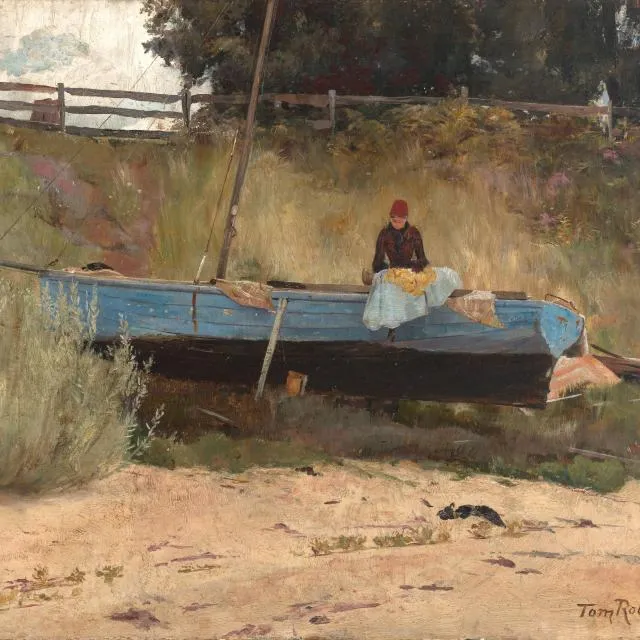
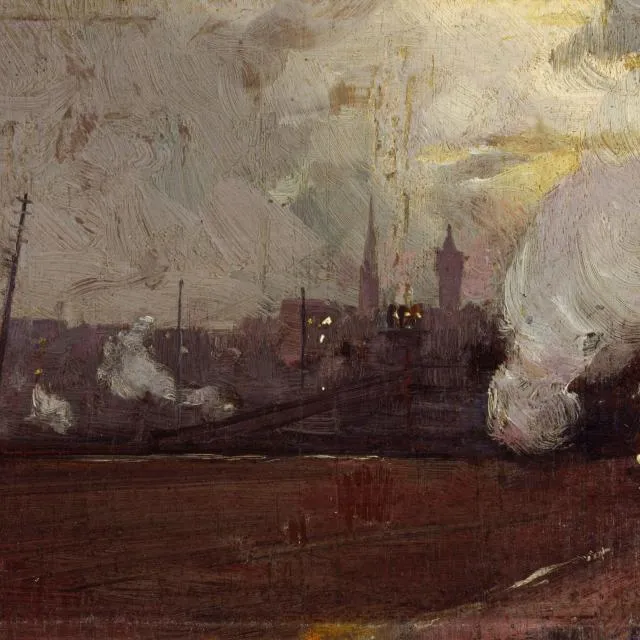
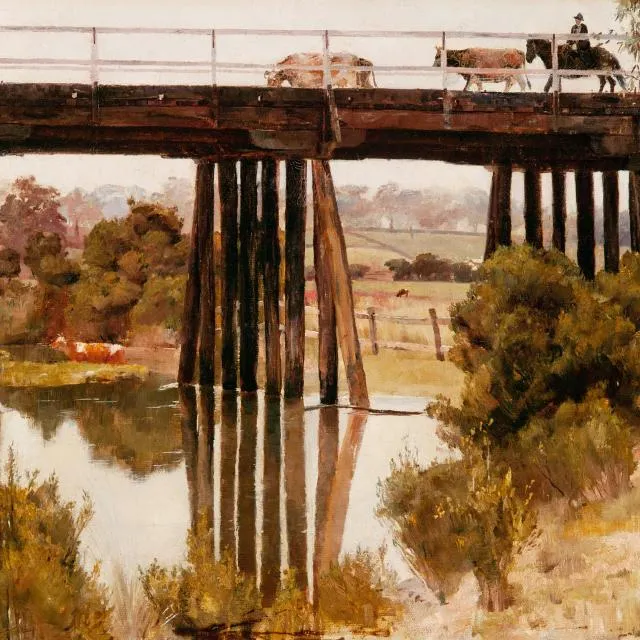
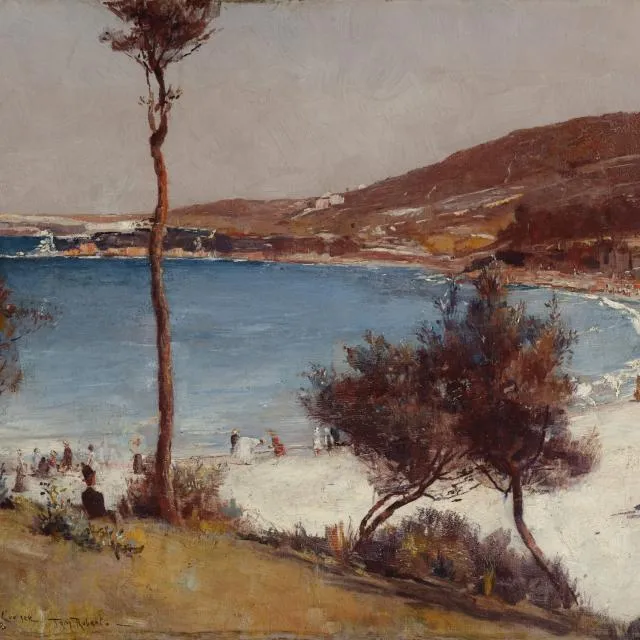
Thomas William "Tom" Roberts (8 March 1856 – 14 September 1931) was an English-born Australian artist and a key member of the Heidelberg School art movement, also known as Australian impressionism.
More by Tom Roberts
Comments (0)
No comments yet. Be the first to share your thoughts.