

Sir Peniston and Lady Lamb, Later Lord and Lady Melbourne, with Lady Lamb's Father, Sir Ralph Milbanke, and Her Brother John Milbanke ('The Milbanke and Melbourne Families')

about 1769 · Oil on canvas
Dimensions 97.2 x 147.3 cm
Collection: National Gallery, London
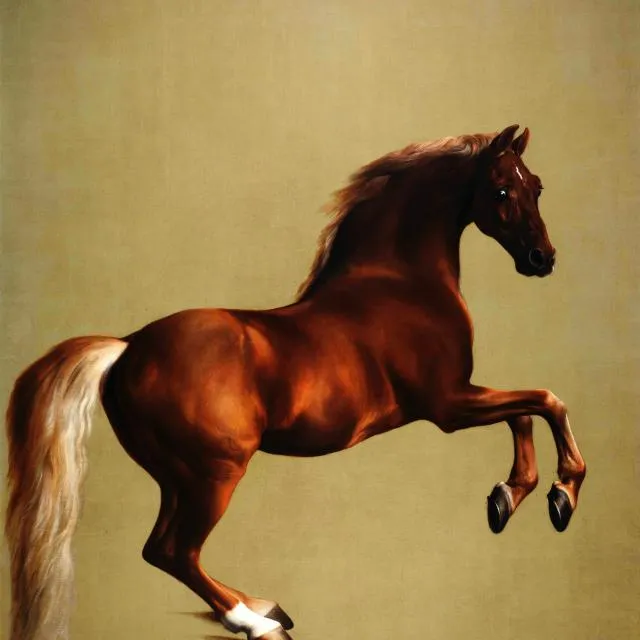
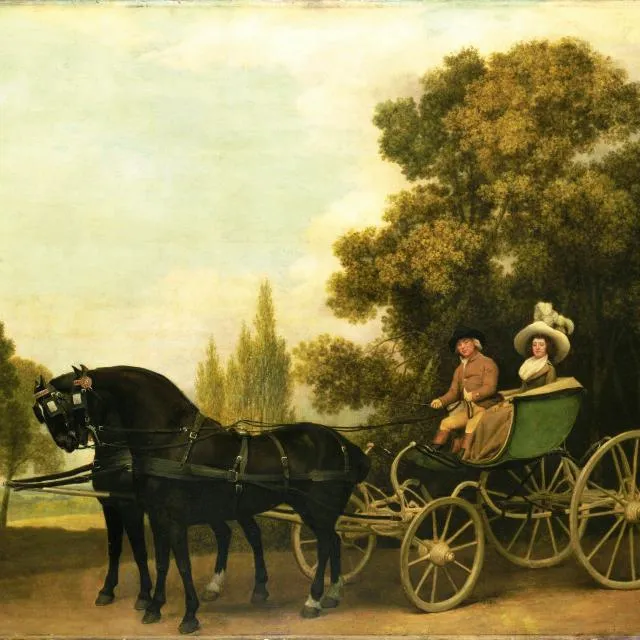
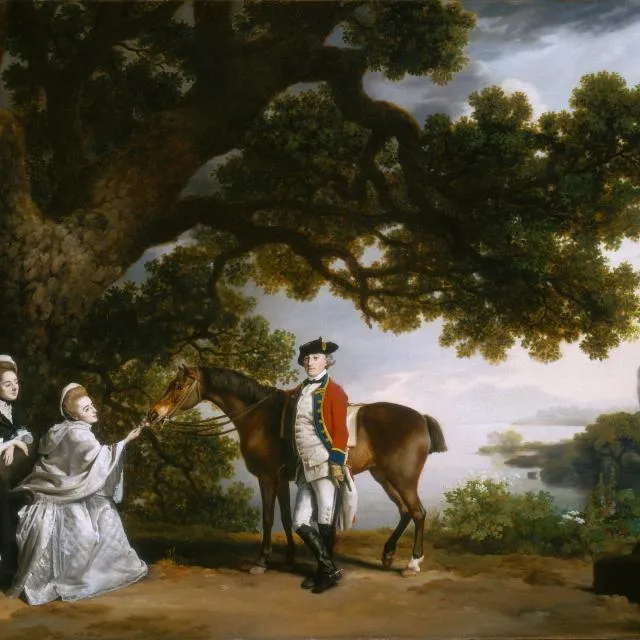
This painting was almost certainly commissioned to commemorate the alliance of the Milbanke and Melbourne families through marriage on 13 April 1769. The married woman is Elizabeth Milbanke and her husband is Peniston Lamb, 1st Lord Melbourne, mounted on a chestnut horse on the right. Elizabeth’s father, Sir Ralph Milbanke, is beside her. The figure standing crossed-legged in the middle is most likely Elizabeth’s elder brother, John Milbanke. Stubbs exhibited the painting as ‘A Conversation’ (a shortened version of ‘a conversation piece’) at the Society of Artists in 1770, the only occasion he used this title for a picture.The two families were not matched in either status or wealth. Although an established and respected county family, the Milbankes were less affluent than the Melbournes. As Peniston Lamb had inherited a considerable fortune, Elizabeth married into money. She was just 16 when she married Peniston, who was 24. Their first child was born just over a year later, on 8 June 1770, so Elizabeth would have been 17 and pregnant when she posed for the portrait. She is seated in a ‘phaeton’ carriage, which had been the centrepiece of a previous portrait by Stubbs, also in the National Gallery’s collection. Placing her in the carriage allowed Stubbs to include her grey pony, which contrasts with the impressive chestnut horse of Arabian stock that Lord Melbourne sits upon. As seen in his large painting Whistlejacket, this breed is distinguished by its long neck, the concave profile of its head and its delicate ears. Peniston Lamb had previously commissioned Lion attacking a Horse (1769, Tate Britain) from Stubbs. He knew the artist had a deep understanding of animal anatomy, and in choosing him to paint this commemorative portrait he would have been confident of his ability to paint a horse of such pedigree.Stubbs would have probably painted each figure individually, rather than have them pose as a group, which may account for the lack of interaction between them. However, their almost symmetrical placement within the same horizontal band of shallow space, which echoes the structure of a classical frieze, and their equal scale, helps to unify them. The broad spread of the large oak tree’s branches also reinforces the link between the two families. Sir Ralph’s gaze across the picture towards his daughter’s husband, which is complemented by the upward glance of the hunting dog, further connects the group. The rocky outcrop on the right was a landscape feature that Stubbs often used, but here it may represent Creswell Crags, on the Nottinghamshire–Derbyshire border, alluding to Lord Melbourne’s connections with Derbyshire.Of the four figures in the portrait, it was Elizabeth who achieved fame, even notoriety, for her social climbing. A highly ambitious woman, she was eager to promote her children. Her most famous son, William Lamb (1779–1848), 2nd Lord Melbourne, became Prime Minister and adviser to the young Queen Victoria. A well-known figure in fashionable society, Lady Melbourne became a close friend of the poet, Lord Byron, after he married her niece, Annabella Milbanke, in 1812. Byron described Lady Melbourne as ‘a supreme woman’, adding, ‘Her defects I could never perceive, as her society makes me forget them and everything else for the time.’
65 collected·57 zoomed·0 comments
About this artwork
Sir Peniston and Lady Lamb, Later Lord and Lady Melbourne, with Lady Lamb's Father, Sir Ralph Milbanke, and Her Brother John Milbanke ('The Milbanke and Melbourne Families') (about 1769) by George Stubbs, oil on canvas, from the National Gallery, London collection.
About George Stubbs
George Stubbs ARA (25 August 1724 – 10 July 1806) was an English painter, best known for his paintings of horses. Self-trained, Stubbs learnt his skills independently from other great artists of the eighteenth century such as Reynolds or Gainsborough.
More by George Stubbs

Comments (0)
No comments yet. Be the first to share your thoughts.