

Swimming (The swimming hole)

1885 · Oil on canvas
Dimensions 70.1 × 93 cm
Collection: Art Whisperer
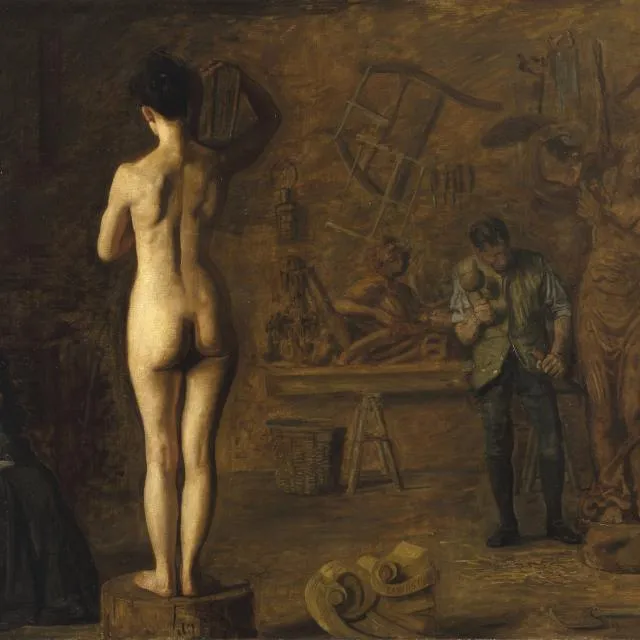
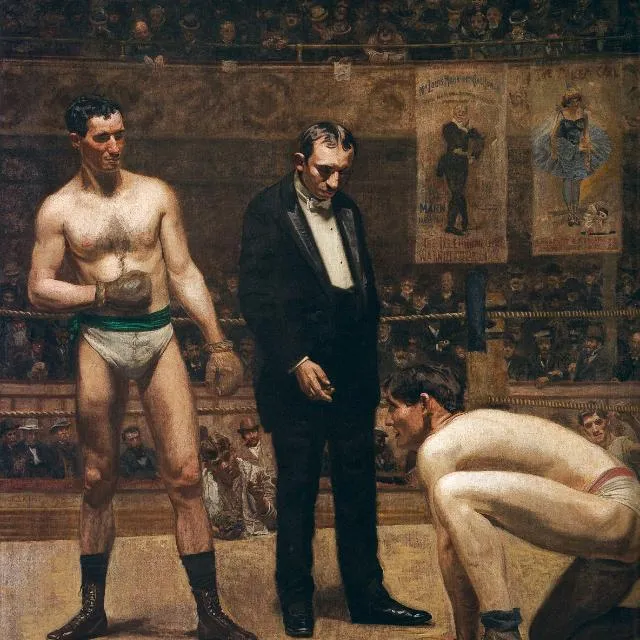
The Swimming Hole (also known as Swimming and The Old Swimming Hole) is an 1884–85 painting by the American artist Thomas Eakins. It depicts six men swimming naked in a lake, and is considered a masterpiece of American painting. According to art historian Doreen Bolger it is "perhaps Eakins' most accomplished rendition of the nude figure",and has been called "the most finely designed of all his outdoor pictures". Since the Renaissance, the human body has been considered both the basis of artists' training and the most challenging subject to depict in art,[and the nude was the centerpiece of Eakins' teaching program at the Pennsylvania Academy of the Fine Arts. For Eakins, this picture was an opportunity to display his mastery of the human form. In this work, Eakins took advantage of an exception to the generally prudish Victorian attitude to nudity: swimming naked was widely accepted, and for males was seen as normal, even in public spaces. Eakins was the first American artist to portray one of the few occasions in 19th-century life when nudity was on display. The Swimming Hole develops themes raised in his earlier work, in particular his treatment of buttocks and his ambiguous treatment of the human form; in some cases it is uncertain as to whether the forms portrayed are male or female. Such themes had earlier been examined in his The Gross Clinic (1875) and William Rush (1877), and would continue to be explored in his paintings of boxers (Taking the Count, Salutat, and Between Rounds) and wrestlers (Wrestlers). Although the theme of male bathers was familiar in Western art, having been explored by artists from Michelangelo to Daumier, Eakins' treatment was novel in American art at the time. The Swimming Hole has been "widely cited as a prime example of homoeroticism in American art". The painting was commissioned in 1884 by Edward Hornor Coates, a Philadelphia businessman who chaired the Committee on Instruction at the Pennsylvania Academy of the Fine Arts, where Eakins taught. Coates intended to pay Eakins $800 ($ 23,000 in 2019 dollars), which at the time was the largest commission Eakins had been offered. Coates intended the painting for an exhibition at the Pennsylvania Academy of the Fine Arts, and it was shown at the Academy's exhibition in the fall of 1885. However, Coates rejected it as unrepresentative of Eakins' oeuvre. In a November 27, 1885 letter to Eakins, Coates reasoned: "As you will recall one of my chief ideas was to have from you a picture which might some day become part of the Academy collection. The present canvas is to me admirable in many ways but I am inclined to believe that some of the pictures you have are even more representative, and it has been suggested would be perhaps more acceptable for the purpose which I have always had in view. You must not suppose from this that I depreciate the present work—such is not the case." It is not known precisely why Coates failed to purchase the painting; however, it seems likely that Coates felt the work was too controversial to acquire. Coates, as Head of Instruction at Eakins' academy, would have been familiar with the subject matter of Eakins' works, and thus it seems unlikely that the nudity in the painting would have surprised or shocked him. Rather, it seems certain that Coates would have recognized the majority of men in the painting, as all but one were students of Eakins at the academy. He was undoubtedly familiar with the site depicted in the painting too, as it was only a half a mile (800 m) from Haverford College, where Coates studied as an undergraduate. The depiction of a professor and his students together in the nude would have been a sensitive subject for the academy's directors, who had forbidden Eakins from using Academy students as models, as modeling was considered indecent. Coates chose to exchange The Swimming Hole for the "less controversial genre scene" of Eakins' The Pathetic Song—today housed in the Corcoran Gallery of Art— and paid Eakins the $800 he had offered for the original commission. On February 9, 1886, Eakins was forced to resign from the Academy because of his removal of a loincloth from a male model in a class where female students were present. In a letter to Coates on February 15 in which Eakins explained his reasons for resigning, he addressed the issue of nudity in his artwork: "My figures at least are not a bunch of clothes with a head and hands sticking out but more nearly resemble the strong living bodies that most pictures show. And in the latter end of a life so spent in study, you at least can imagine that painting is with me a very serious study. That I have but little patience with the false modesty which is the greatest enemy to all figure painting. I see no impropriety in looking at the most beautiful of Nature's works, the naked figure. If there is impropriety, then just where does such impropriety begin? Is it wrong to look at a picture of a naked figure or at a statue? English ladies of the last generation thought so and avoided the statue galleries, but do so no longer. Or is it a question of sex? Should men make only the statues of men to be looked at by men, while the statues of women should be made by women to be looked at by women only? Should the he-painters draw the horses and bulls, and the she-painters like Rosa Bonheur the mares and cows? Must the poor old male body in the dissecting room be mutilated before Miss Prudery can dabble in his guts? ... Such indignities anger me. Can not anyone see into what contemptible inconsistencies such follies all lead? And how dangerous they are? My conscience is clear, and my suffering is past."
310 collected·734 zoomed·2 comments·4 boards
This artwork is in 4 boards
About this artwork
Swimming (The swimming hole) (1885) by Thomas Eakins, oil on canvas, from the Art Whisperer collection.
About Thomas Eakins
Thomas Cowperthwait Eakins (July 25, 1844 – June 25, 1916) was an American realist painter, photographer,[1] sculptor, and fine arts educator. He is widely acknowledged to be one of the most important artists in American art history.
More by Thomas Eakins
Comments (0)
No comments yet. Be the first to share your thoughts.