

The Coronation of the Virgin: Central Main Tier Panel

1407-9 · Egg tempera on wood
Dimensions 220.5 x 115.2 cm
Collection: National Gallery, London
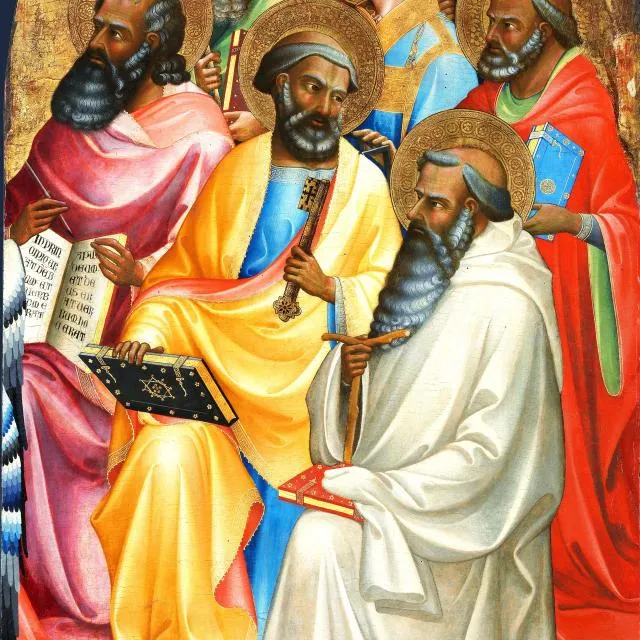
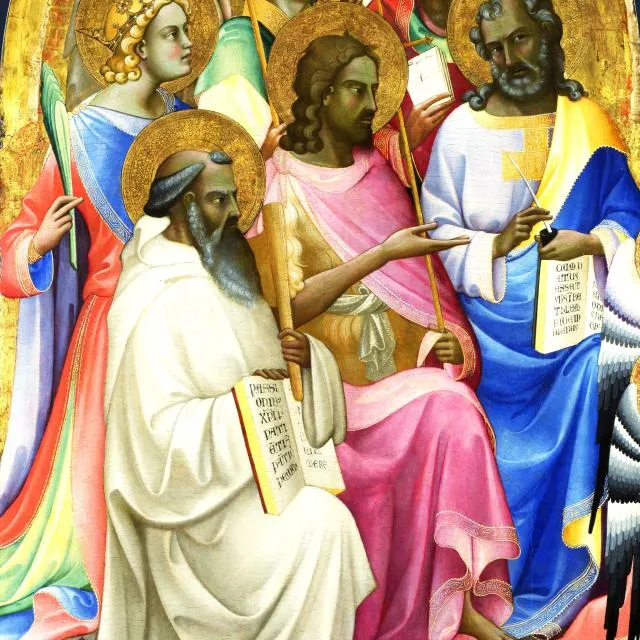
Seated on a delicate throne and dressed in glowing colours, Christ places a jewelled and gilded crown on his mother Mary’s head. Graceful angels kneel before them, swinging censers of incense and making music. This is the coronation of the Virgin, the final drama of Mary’s life, and a very popular subject in medieval and Renaissance Italy. According to Christian legend, Mary’s soul was carried up to heaven after her death and she was crowned as Queen of Heaven.This feast of gold and colour is a perfect example of early Renaissance painting. It originally appeared in the centre of a very large polyptych painted by Lorenzo Monaco for the monastery of San Benedetto fuori della Porta Pinti in Florence. Other panels from the same altarpiece survive in the National Gallery and in other collections.The composition, with Christ and the Virgin together on a single throne surrounded by angels and saints, was derived from an altarpiece Giotto made around 1334 for the Baroncelli chapel. It was repeated on many fourteenth- and fifteenth-century Florentine altarpieces (like Jacopo di Cione’s The Coronation of the Virgin).The gorgeous colours are carefully arranged to complement each other and set up visual harmonies across the panel. Christ’s brilliant blue mantle – painted with lapis lazuli, a pigment more expensive than gold – is set off by the glowing yellow of its lining and the pink of his tunic; all are echoed in the dress of the angel with the barrel organ who kneels before the throne. On either side of the throne angels with golden hair and delicate pink cheeks gaze up adoringly, their lips open in songs of praise, their careful symmetry emphasised by their matching outfits.Lorenzo Monaco was especially skilled at gilding techniques. The gilding of the background and haloes was done first, before the painting, and you can see the red bole where the gold of the background has worn away. The haloes of the angels, Christ and the Virgin were burnished and then stamped with different punches to create patterns which would have flickered in the candlelight.The sgraffito cloth of honour was painted with vermilion, a red pigment, over burnished gold that was punched to suggest raised gold threads. The cushion on which Christ and the Virgin sit has been modelled by punching to suggest the light and shade of its folded fabric. Mordant gilding, where gold leaf is applied over a glue, decorates the edges and hems of the draperies: look closely and you can see the delicate fringe around the edge of the Virgin’s veil.Some of the colours have changed over time: the Virgin’s robe has almost entirely faded from a deep pinkish-mauve to white, and the vermilion of the cloth of honour has darkened. The gilded inscription along the base of the parapet is now almost invisible. At some point an arched doorway was cut into the centre of the panel for a tabernacle to store the bread of the Eucharist. It does not seem to have been original, and had been filled in and painted over before the eighteenth century.
60 collected·38 zoomed·0 comments
About this artwork
The Coronation of the Virgin: Central Main Tier Panel (1407-9) by Lorenzo Monaco, Egg tempera on wood, from the National Gallery, London collection.
More by Lorenzo Monaco
Comments (0)
No comments yet. Be the first to share your thoughts.