

The Dead Christ supported by Saints

about 1465 · Egg on wood
Dimensions 26.4 x 21 cm
Collection: National Gallery, London
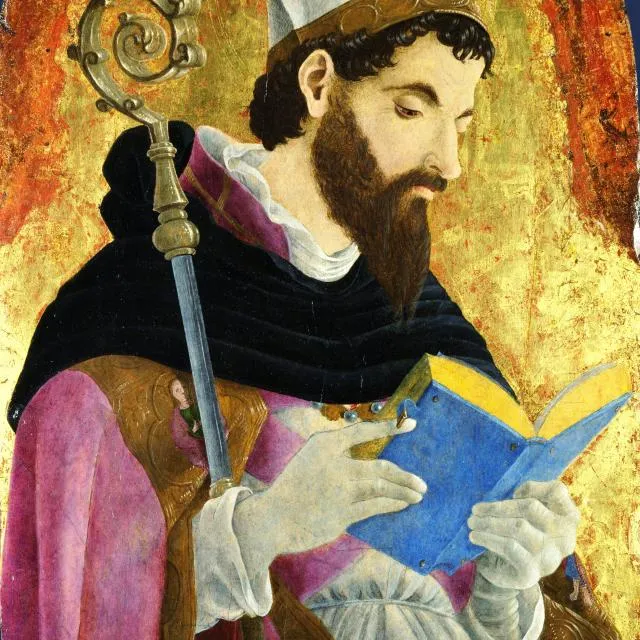
Two slender candles, flames extinguished, smoulder on Christ’s tomb. Christ is shown after his death, his emaciated body propped up against the back edge of the tomb, his hand lying limp upon the marble. This type of image was sometimes known as the ‘Imago Pietatis’ (‘image of pity’), or Pietà.Standing behind a parapet are Saint Jerome, who cradles Christ’s head, and Saint John the Baptist. Saint Jerome wears the cowl (hooded cloak) of a hermit over blue robes, a reminder to contemporary viewers of the saint’s time in the desert, where, in contemplation of Christ’s suffering at the Crucifixion, he practised self-flagellation, beating his chest with a rock in empathy with Christ. Saint John the Baptist also spent time in the wilderness, preaching about Christ. According to the Gospel of John, he ate only locusts and honey, and wore a rough camel-skin tunic. In this painting, tufts of hair peek out of the inner face of his tunic.The choice of saints is fitting for this kind of image, which was intended to promote empathy with the suffering of Christ, but it is unusual: it was more common for Christ to be shown propped up by angels, as in Giovanni Bellini’s picture in our collection and in another Pietà by Zoppo in the Musei Civici, Pesaro. There are no earlier examples with saints in the Veneto region of Italy, where these kinds of images were particularly popular. The saints‘ direct communication with Christ here transforms the image into a sacra conversazione (’holy conversation'), an innovative format in the late fifteenth century. The direct interaction between Jerome and Christ is comparable to Ercole’s panel from the diptych made for Eleonora of Aragona, the Duchess of Ferrara.Images of the dead Christ often formed the uppermost part of a polyptych, such as Giorgio Schiavone’s panel in our collection. This one, however, has a pattern on the reverse which imitates the precious red and white stone called porphyry, used for decoration in ancient Rome. This suggests that the panel was intended to be held and moved around, rather than viewed only from the front. It was probably made for private prayer. We do not know who commissioned the picture but it was probably made in Venice, where Zoppo would have seen examples of the type by Bellini.The soft folds of the fabrics in pastel colours, which appear luminous as they reflect the light, are characteristic of Zoppo’s unique style and reflect his skill as a draughtsman who could create clear and crisp designs full of graceful, flowing curves.
50 collected·38 zoomed·0 comments
About this artwork
The Dead Christ supported by Saints (about 1465) by Marco Zoppo, Egg on wood, from the National Gallery, London collection.
More by Marco Zoppo
Comments (0)
No comments yet. Be the first to share your thoughts.