

The Finding of Moses

1651 · Oil on canvas
Dimensions 115.7 x 175.3 cm
Collection: National Gallery, London
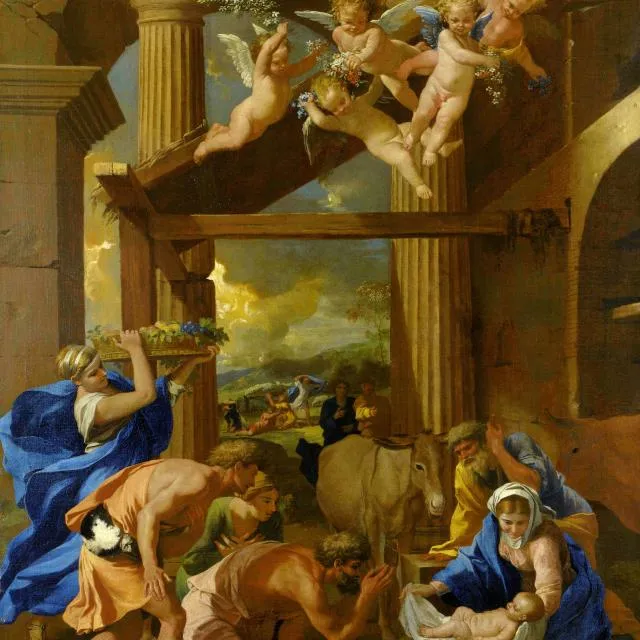
According to the Old Testament Book of Exodus, Pharaoh ordered all Israelite baby boys to be cast into the river, but Moses’s mother hid him in a basket among the bulrushes. He was discovered there by Pharaoh’s daughter, Thermutis, who is shown here dressed in a yellow robe and surrounded by her maidens. Moses is cradled by his sister, Miriam, dressed in white.Thermutis decides to spare Moses from death and eventually adopts him. The joy of this event is reflected in Thermutis’s welcoming smile and the excited gestures of her companions, whose fluttering clothing shows their hurried movement towards the infant. To the right, a woman catches our eye as she steps out of the water. The palm trees and statue of a sphinx, a mythical creature with a human head and lion’s body, tell us the scene is taking place in Egypt. Colourful clothing shimmers in the sunlight, conveying the warmth of the Egyptian climate.Poussin takes inspiration from ancient Roman architecture and from recently discovered mosaics in Rome. The unusual-looking building in the centre with a large vase on the roof to collect water is based on a mosaic discovered in around 1600 in the Temple of Fortuna at Praeneste. Poussin was familiar with this building through watercolour studies of it owned by his patron, Cassiano dal Pozzo. The figures, with their idealised bodies and extravagant drapery, are also based on sculptures from classical antiquity.Poussin painted three, or possibly four, versions of this subject. Two of these paintings were in the collection of Louis XIV and are now in the Louvre, Paris. Painted in 1651 for Benardin Reynon (1613–1686), a Lyon silk merchant, this is the last and most accomplished version. It had many prestigious owners: the Duc de Richelieu (1629–1715), the great-nephew of Cardinal Richelieu, and later in the seventeenth century, Jean-Baptiste Colbert, Marquis de Seignelay (1651–1690), whose widow is portrayed in Mignard’s The Marquise de Seignelay and Two of her Sons, also owned by the National Gallery.This subject was often painted during the Renaissance and seventeenth century. Painters commonly made connections between images of the infant Moses and the young Jesus Christ escaping the Massacre of the Innocents. The four maidens on the left of this painting recall the shepherds in scenes of the Adoration and Thermutis’s pose derives from images of the Virgin. Poussin clearly revelled in painting this engaging work: the women are carefully arranged within an ordered composition, and he uses a variety of poses and expressions and vibrant colouring. An expensive ultramarine blue pigment is used for the green and blue robes as well as areas in shadow and the grey buildings.We own other paintings on the theme: Bartholomeus Breenbergh’s The Finding of the Infant Moses by Pharaoh’s Daughter, and Antonio De Bellis’s The Finding of Moses, and on loan to our collection is Orazio Gentileschi’s The Finding of Moses.
69 collected·88 zoomed·0 comments
About this artwork
The Finding of Moses (1651) by Nicolas Poussin, oil on canvas, from the National Gallery, London collection.
About Nicolas Poussin
Nicolas Poussin (June 1594 – 19 November 1665) was the leading painter of the classical French Baroque style, although he spent most of his working life in Rome. Most of his works were on religious and mythological subjects painted for a small group of Italian and French collectors.
More by Nicolas Poussin

Comments (0)
No comments yet. Be the first to share your thoughts.