

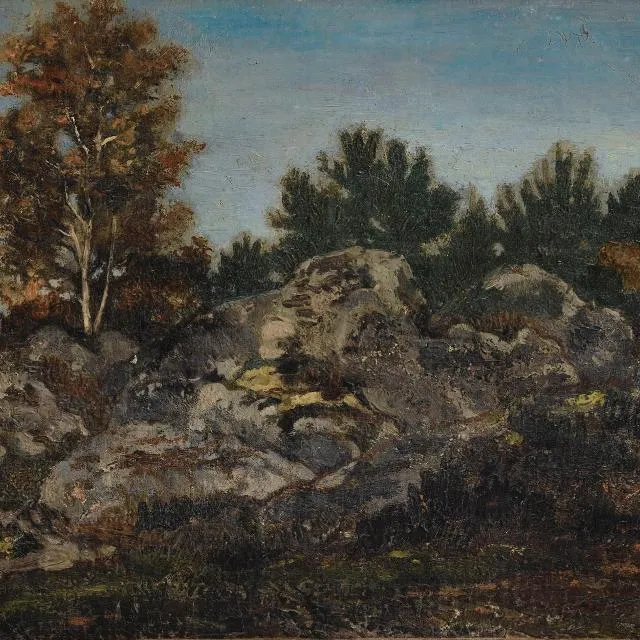
The Forest of Fontainebleau

1850s-1860s · Oil on canvas
Dimensions 29.8 x 38.1 cm
Collection: National Gallery, London
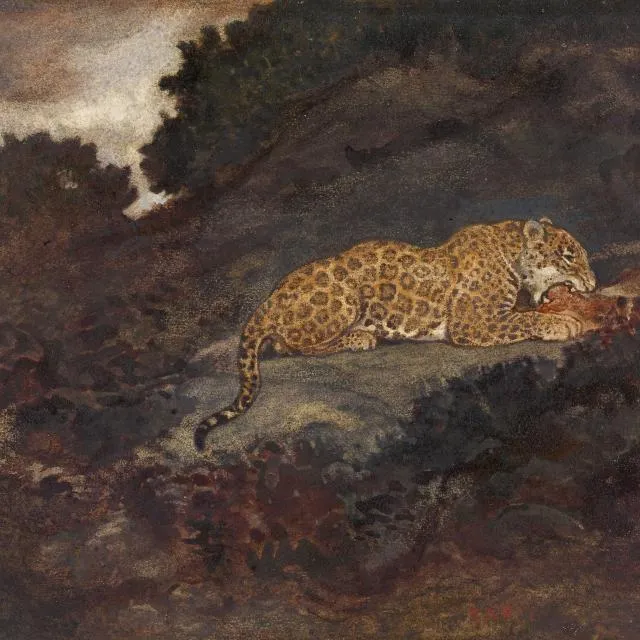
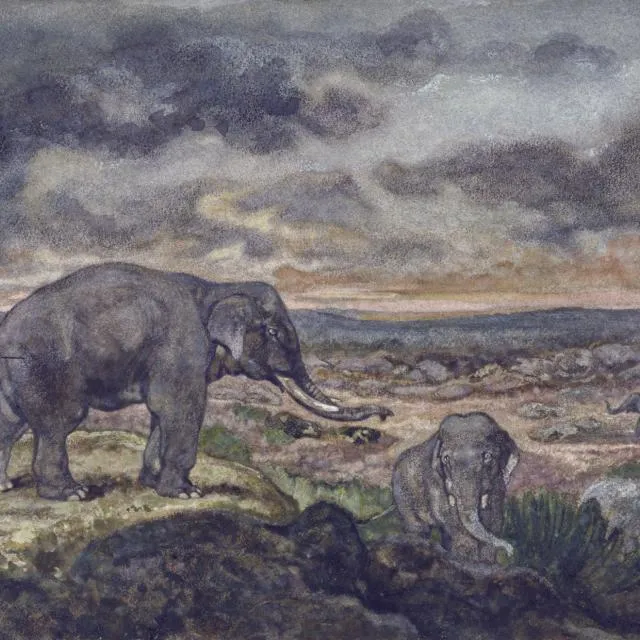
Trained as a goldsmith, Barye was primarily a sculptor, particularly of animal bronzes, who was hailed as ‘the Michelangelo of the menagerie’ by the writer and critic Théophile Gautier. In 1841, when in his mid-forties, he began painting landscapes in oil, and by the end of the decade he was regularly visiting the forest of Fontainebleau. This was a popular location for artists in the mid-nineteenth century, especially the area in and around the village of Barbizon. At Fontainebleau he painted alongside members of the Barbizon group of landscape painters including Millet and Diaz. Barye never exhibited his oil paintings, which only became known to the public at a posthumous exhibition of his work in 1875 and at a sale in 1876 (which included 99 oil paintings).Barye’s oils are characterised by dark colours and thick impasto paint to build up form and structure, his technique influenced by other Barbizon artists, especially Rousseau and Alexandre-Gabriel Decamps (for whom Corot was to paint The Four Times of Day). But he also worked in watercolour, a medium in which he excelled, producing pictures of African and Asian animals such as lions, tigers and elephants. Unlike his oils, he did exhibit and sell his animal watercolours, which received critical acclaim. In his review of an exhibition in 1860 that included Barye’s watercolours, Gautier noted, ‘No one has mastered the wild animal like Barye. Was he a gladiator in some Roman circus? … With respect to tigers, only Delacroix and Méry are in Barye’s class.’Painted in the 1850s or 1860s, this small picture most likely shows a gorge in the forest at Fontainebleau. We are looking up a gently sloping rocky hillside, which is dotted with trees (including a prominent silver birch in the right middle ground), rounded mossy rocks and larger, more irregular boulders. Barye was particularly drawn to the more remote and desolate sites in and around the forest such as the rocky gorges at Franchard and at Apremont (which he painted for a picture now in the Louvre). A solitary bird flies across the relatively small area of blue sky. Despite this patch of sky, the scene feels dark and claustrophobic – Gautier, for example, noted that even in Barye’s watercolours, ‘the landscape backgrounds lack air.’ Apart from occasional deer, Barye’s oil landscapes do not usually include people or animals, but instead evoke an almost primordial terrain. Not surprisingly, perhaps, the rocky landscapes of Fontainebleau appear in many of his animal pictures. An 1889 catalogue of his work observed that, ‘without straying far from Paris, he conceived many of his numerous watercolours … combining data borrowed from nature with his inner visions, he created little landscape settings of a strange and truly exotic character in which ferocious beasts seem to be at home.’
59 collected·46 zoomed·0 comments
About this artwork
The Forest of Fontainebleau (1850s-1860s) by Antoine-Louis Barye, oil on canvas, from the National Gallery, London collection.
About Antoine-Louis Barye
Antoine-Louis Barye was a Romantic French sculptor most famous for his work as an animalier, a sculptor of animals. His son and student was the known sculptor Alfred Barye.
More by Antoine-Louis Barye
Comments (0)
No comments yet. Be the first to share your thoughts.