

The Friedrichsgracht, Berlin

probably 1830s · Oil on paper laid down on millboard
Dimensions 25.5 x 44.6 cm
Collection: National Gallery, London
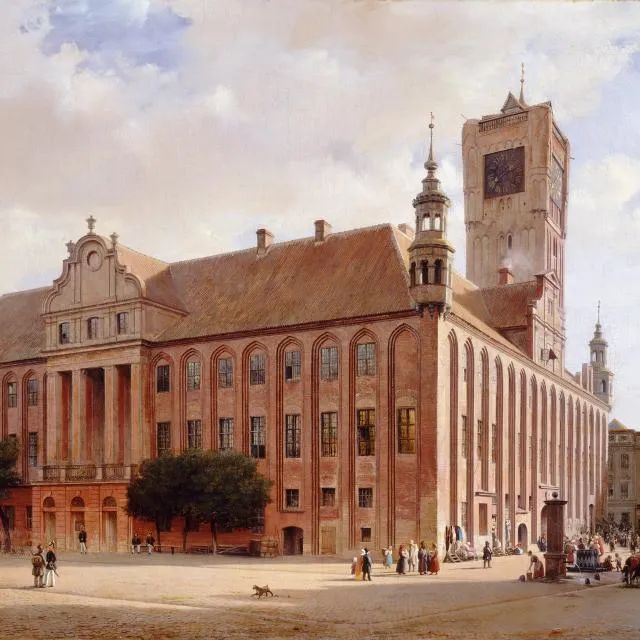
The Friedrichsgracht was a canal that ran though the centre of Berlin. While it still survives in present-day Berlin, much of the area has been rebuilt since the Second World War. This striking composition, dominated by the geometrical precision of the zinc roof in the foreground, is typical of Gaertner’s work. His style is naturalistic and precise, scenes resemble snapshots of everyday life in the city but also reflect a preoccupation with atmosphere and light that has led to him being called ‘the Prussian Canaletto’.The building in the foreground was the property of a prominent art collector in Berlin, Pierre Louis Ravené, who may have commissioned Gaertner to paint this view. He moved his business to these premises in 1833, and it is possible that the picture was painted shortly afterwards. Although the style is similar to Gaertner’s work of the 1830s, Ravené was mainly active as a collector after 1845, so the picture could have been painted later. The relatively small scale of the work and the lack of signature suggest that it may be a study for a larger painting but no other picture of this view by Gaertner has survived.Gaertner began his career with an apprenticeship at the Royal Porcelain Factory in Berlin and later took drawing classes at the Academy of Arts. In 1821, he started work in the studio of Carl Wilhelm Gropius, the court theatre painter, where he became increasingly attracted to architectural painting. After a trip to Paris, he developed his skills in the manipulation of light and atmosphere, and was inspired to devote himself almost entirely to painting architectural views.On his return to Berlin, he started painting views of the buildings of the city, such as this one, and also produced a series of scenes depicting the castles in Bellevue, Charlottenburg and Glienicke, mainly for royal customers. In 1833, he was admitted to the Academy and designated a ‘Perspective Painter’. The following year, he began his most famous work: a six-panel panorama of Berlin that was purchased by the King of Prussia – a second version was bought by the King’s daughter, Tsarina Alexandra Feodorovna, leading to a trip to Russia.However, when King Friedrich Wilhelm III died in 1840, his successor, Friedrich Wilhelm IV, who preferred Italian-style paintings, bought very little from Gaertner. As the century progressed he was also under direct competition from the new medium of photography. It is believed that he made use of a camera obscura to sketch the layouts of his paintings. Infra-red photography has revealed an extremely precise pencil underdrawing for this particular painting with the entire composition mapped out in great detail. Gaertner also possessed a collection of photographs, but there is no evidence that he used these as models.
71 collected·60 zoomed·0 comments·1 boards
This artwork is in 1 board
About this artwork
The Friedrichsgracht, Berlin (probably 1830s) by Eduard Gaertner, oil on paper laid down on millboard, from the National Gallery, London collection.
About Eduard Gaertner
Johann Philipp Eduard Gaertner (2 June 1801, Berlin – 22 February 1877, Flecken Zechlin, in Rheinsberg) was a German painter who specialized in depictions of urban architecture.
More by Eduard Gaertner
Comments (0)
No comments yet. Be the first to share your thoughts.