

The Grounds of the Château Noir
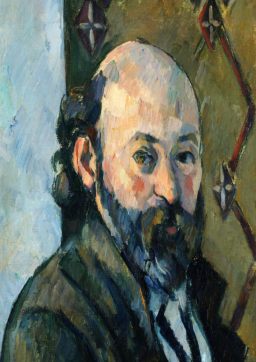
about 1900-4 · Oil on canvas
Dimensions 90.7 x 71.4 cm
Collection: National Gallery, London
The Château Noir was a rambling house situated in extensive grounds between Aix-en-Provence and Le Tholonet in the south of France. Cézanne rented a small room in the house from 1897 and tried, unsuccessfully, to buy the property two years later when his family home, the Jas de Bouffan, was sold. Surrounded by wild vegetation, the run-down buildings of the isolated chateau offered Cézanne a variety of motifs, and it became one of his favourite locations. Although he stopped renting a room in 1902, when he moved into his newly completed studio at nearby Les Lauves, he continued to paint in the grounds until his death in 1906, travelling there by hired car.We are looking at a group of trees growing along a remote rocky ridge on a hill north-east of the house. The diagonal slope of the hill is so steep that the rocks seem close to tumbling out of the frame. However, just as objects do not fall from the tilted tabletops in many of Cézanne’s still-life paintings, these boulders remain in place as if defying gravity. Dense woodland that writhes up from the rocks forms a screen that almost blocks out the sky, which we only glimpse towards the top of the picture as areas of pale blue. Some light, indicated by patches of blue on the ground, does filter through gaps in the thick foliage – an instance of Cézanne’s statement to the artist and writer Maurice Denis that ‘it is impossible to reproduce light, it must be represented by something else, by colours’.A small patch of orange near the picture’s centre provides a focal point that is echoed by the orange-ochre and browns of the ground. Although these warmer tones contrast with the cooler greens and slate greys of the tree trunks and foliage, the picture’s overall palette of grey, brown and deep green remains dark. These colours, together with Cézanne’s use of overlapping faceted brushstrokes to create an almost sculptural effect, were to be adopted by Picasso and Braque during the early stages of Cubism in the first decade of the twentieth century.The picture’s sombre colours, in conjunction with the high horizon and barely visible sky, also contribute to its somewhat oppressive, even claustrophobic atmosphere, which is very different from the bright tones and almost classical formal balance of Avenue at Chantilly, painted some ten years earlier. While the earlier painting leads our eye into the landscape, our vision here is blocked by the rocks and trees and remains trapped within the picture’s shallow space. In his final years Cézanne was increasingly drawn to harsh landscapes untouched by human intervention, perhaps finding in their stark grandeur and elemental power an image of his own dark moods, and maybe an echo of the violence within some of his earliest work.
75 collected·76 zoomed·0 comments
About this artwork
The Grounds of the Château Noir (about 1900-4) by Paul Cezanne, oil on canvas, from the National Gallery, London collection.
About Paul Cezanne
(19 January 1839 - 22 October 1906) Paul Cezanne was a French painter. He was born in Aix-en-Provence, in the south of France, and died of pneumonia there. The artistic career of Paul Cézanne lasted more than forty years, from roughly 1860 to 1906.
More by Paul Cezanne
Comments (0)
No comments yet. Be the first to share your thoughts.