

The Heavenly and Earthly Trinities ('The Pedroso Murillo')
about 1675-82 · Oil on canvas
Dimensions 293 x 207 cm
Collection: National Gallery, London
This painting illustrates the belief that Christ was both human and divine: the embodiment of the ‘Two Trinities’. At the centre of the composition the Christ Child forms both a vertical and a horizontal link with the figures around him, reinforcing the picture’s principle message.Together with the hovering dove of the Holy Ghost and the figure of God the Father above, Christ forms part of the Holy or Heavenly Trinity. He looks up towards heaven, but affectionately holds hands with his human parents, Mary and Joseph. Together they make up the holy family, which was sometimes referred to as the Earthly Trinity, especially during the Counter-Reformation period.The subject of the ‘Two Trinities’ was rarely painted in Spain during the seventeenth century. This is one of Murillo’s most ambitious works and it demonstrates his ability to transform a complex theological principle into a very human and accessible image.The scene is not based on a particular biblical event, though a story in the Gospel of Luke echoes its theme. When Christ was 12 years old he was taken by his parents to Jerusalem to celebrate Passover; shortly after leaving they realised he was not with them. They found him three days later in the Temple, debating with religious scholars who were amazed at his great wisdom (Luke 2: 41–50). When confronted by his anxious parents Christ spoke simply of his divine mission.The painting is one of extraordinary tenderness. Mary’s loving gaze and gracefully upturned palm are directed towards her young son. Joseph looks out of the picture towards us, inviting us to adore Christ. He holds a rod bursting into flower, one of his attributes, to signify his betrothal to Mary. Christ stands on a sharp-edged rock, possibly intended to symbolise an altar or refer to biblical descriptions of him as the ‘cornerstone’ upon which God’s household would be built (Matthew 21: 42 and Psalm 118: 22).Though the painting’s early history is unrecorded, the title by which it has become known, ‘The Pedroso Murillo’, is connected to the Pedroso family. The altarpiece is recorded in their collection for over a century (in 1708 in Cádiz and later in Madrid). It is among Murillo’s last works and clearly showcases the loose and confident brushwork of his late style. It was probably made in 1681–2 when the artist was working on a series of paintings for the Capuchin church in Cádiz. He supposedly fell from scaffolding while painting there and died from his injuries several months later.
68 collected·71 zoomed·0 comments
About this artwork
The Heavenly and Earthly Trinities ('The Pedroso Murillo') (about 1675-82) by Bartolome Esteban Murillo, oil on canvas, from the National Gallery, London collection.
About Bartolome Esteban Murillo
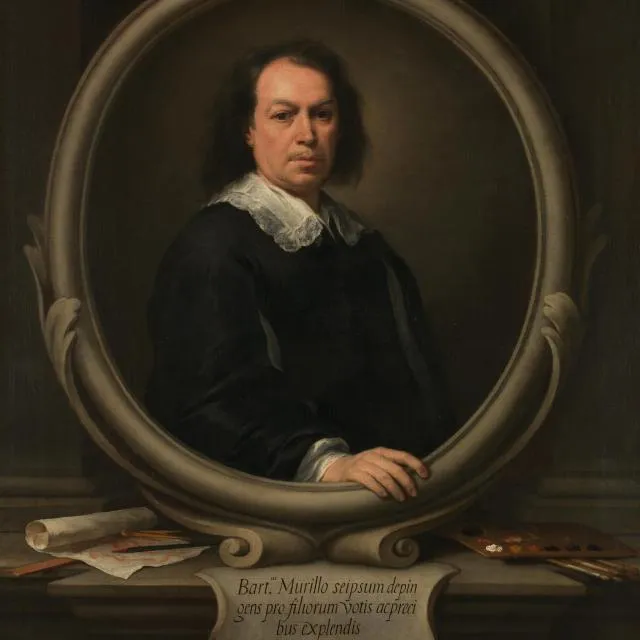
Bartolomé Esteban Murillo (born late December 1617, baptized January 1, 1618 – April 3, 1682) was a Spanish Baroque painter. Although he is best known for his religious works, Murillo also produced a considerable number of paintings of contemporary women and children.
More by Bartolome Esteban Murillo
Comments (0)
No comments yet. Be the first to share your thoughts.